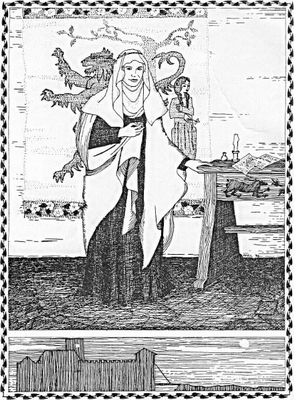
The cell in the tower was bare, apart from a rough wooden bench and a straw mattress: Lady Catherine circled it like a caged hawk. The hem of her black mourning gown swept the floor as she restlessly paced back and forth. Her white veil with its chin band gave her the look of a nun - in her desperation she had considered even that refuge.
 In the past seven
days she had memorized every stone of the massive walls, every splinter
of the floor. She glanced up, judging the hour by one ray of sun that penetrated
a slit high in the wall and moved slowly, like the pointer of a sundial,
around the cell. The light was failing, and with it her courage. During
the days at least she could hear the clatter of carts and servants and
men-at-arms in the courtyard below. The nights, solitary and silent, were
harder to bear .
In the past seven
days she had memorized every stone of the massive walls, every splinter
of the floor. She glanced up, judging the hour by one ray of sun that penetrated
a slit high in the wall and moved slowly, like the pointer of a sundial,
around the cell. The light was failing, and with it her courage. During
the days at least she could hear the clatter of carts and servants and
men-at-arms in the courtyard below. The nights, solitary and silent, were
harder to bear .
Out loud, for there was no one to hear, she declared, "Never. I will never submit. "
By reaching up both hands, she touched the stone sill, imagining that the air was fresher there. The dim light was fading with the sinking sun. Soon she would be alone in a well of darkness, a prey to nameless terrors.
In sudden despair she turned and leaned her arms against the cold stone wall. One sob broke from her. Despite her resolution, hopelessness was sinking iron claws into her heart. She had fought Sir Wallis for so long, and now it seemed that the final battle would end in her defeat.
"Oh father... " she breathed. "You did not intend this to happen. Ambermere was to be a beautiful legacy for me."
She knew the story by heart. The land on which Ambermere Manor now stood had been given to her grandfather only thirty years before, soon after the Norman invasion of Britain in 1066. The very day he planted his banner on the land, his freemen and serfs were put to work constructing a moat and a rampart wall; then a square tower, a stone manor hall with heavy arched windows, and a slate-roofed chapel. The surrounding forests, farmlands, and villages were soon under his control as well.
When her grandfadter died all his possessions passed to Lord Charles, her father . She was his only child, and upon his death, Ambennere should have come to her .But Lady Catherine had learned a bitter lesson during the past ten years: that might makes right.
Ten years earlier, in the brutal winter of 1088, Lord Charles had fallen ill with a cough. Year by year while he drifted deeper into illness, Sir Wallis gradually made himself master of Ambermere. Despite her efforts, she saw her father slowly but relentlessly pushed out of his rightful place; and the struggle bred in her a bone-deep hatred of injustice. Seven days ago, her father had closed his kind, tired eyes for the last time, and the cell door had locked shut on Lady Catherine. It would not open until she agreed to the demands of Sir Wallis.
Only one hope still burned like a candle in her heart: that the lord to whom she had been betrothed as a child would gather his clan and sail from the Heathery Isle to her rescue. She could only pray that her message had reached him, far across the cold gray sea.
"He will come for me -- my knight, my champion. I will not doubt him, I will not fear." Her words were a hollow echo in the darkening tower .
Heavy footsteps on the landing outside made her catch her breath. With the ice of terror in her throat she put her back against the wall, readying herself to face Sir Wallis. But the iron-bound door did not open. Instead, inch by inch, a wooden platter of stew was pushed under the door .
The smell of the greasy stew made her feel ill, but she was determined to keep up her strength. Carrying the platter to the wooden bench, she ate the meat and turnips with her fingers, then drank from a leather bottle of water. Her Scottish maidservant Phemie was allowed to attend her once a day; she would refill the bottle. It was Phemie who had smuggled out that last frantic letter, and bribed a man-at-arms to carry it across the sea. She had no means of knowing if the messenger had reached the castle of Raven's Rock. Perhaps Lord Alistair had already set sail.
Lady Catherine dropped her head into her hands and rocked back and forth. "Gracious God, let it be so."
The bolt slipped back ~ she heard the grinding of an iron bar, and she sprang to her feet to face the nobleman who waddled in. His belly hung over a jeweled swordbelt, his small eyes disappearing into his swollen face like currants in an unbaked loaf of bread. Gray hair plastered his cheeks as if it had been melted by the heat of his flushed skin. Despite his bulk, he was light on his feet, and dressed himself like a Norman courtier in velvet, furs, and jewels.
"Lady Catherine," he said, and bent a creaky knee in salute. His lavish velvet tunic was embroidered with his badge, a red bull. A jeweled brooch pinned his fur - lined mantle at the shoulder. He lifted a candlestick in his plump hand, and his small eyes feasted on Lady Catherine's beautiful face, so cold and pale; her full lips, set in a defiant line; and her clear green eyes that flashed rebellion. "My beauteous young recalcitrant darling."
"Sir Wallis," she said, coldly, and squared her shoulders, facing him resolutely. He must not know how her heart was hammering.
Sir Wallis sighed. His jowls swung back and forth with the shaking of his head. "My dearest, you cannot know how it pains and hurts and wounds me to keep you here. Until you regain your senses, however, it is for your own protection. The priest is below, in the chapel. It is for you to speak the word that will return you to your rightful position as lady of this manor. Your late father named me as your guardian - why do you withhold your trust from me?"
Lady Catherine looked at him steadily. She kept her voice cold and even. "Your priest stood at my father's bedside, your lackeys witnessed the document -- or so they say. Still, despite your scheming, Ambermere and its wide lands are mine, and will be until I wed or until I die. And you will have to put me to death to gain my estates, for I will not wed you, Uncle."
He dabbed his forehead with a square of perfumed linen ~ the climb to the tower had winded him. Or perhaps it was his life-long fury at being set aside in favor of his elder brother Charles. Apart from his title, Sir Wallis had inherited nothing.
Swallowing anger, he said, "That is indeed the painful choice you force upon me. Fortunately for you. I am a man of refinement rather than a barbarian, and I cringe at the thought of violence. You show very little appreciation of my delicate sensibilities. But in the past ten years I have learned not to expect gratitude from you." His mouth pursed as if he were sucking a lemon. "I remember well your little face whitening with anger; your little eyes flashing fire. Those same selfish, obstinate, unmaidenly traits have brought you to this tower."
As so often in the past, she could feel her face growing pale with anger. "Tell me, Uncle - - how are you explaining my imprisonment? What tales are you spreading of me?"
The stale, damp air of the cell did not agree with Sir Wallis. He pulled a perfume bottle from a belt pouch and inhaled the scent to revive himself, then sprinkled it on his handkerchief. " As I said. it is for your own protection. until you come to your senses. Obstinacy in a woman is a sign of madness. Submission to your betters is your primary duty ."
Through set teeth she said. "Is it madness to be faithful? I am promised to another. "
He tittered, but it was not a happy sound. "The two who planned the alliance, Lord Alistair's father and yours, are dead. It was a foolish promise made to each other in the heat of battle, when they both happened to be slaves of Viking marauders." He flipped his hand in distaste. "Charles rescued the Scots lord, or perhaps the Scots lord rescued him - -I have no liking for such tales of gore and savagery. In any case, you have no one to turn to now but me. "
She gripped her hands together to keep them from trembling. "I have kept faith with that pledge. If he is faithful as well, one day I will be the Lady of Raven's Rock."
His anger was deepening, turning his engorged face purple with rage. "You would not find happiness at Raven's Rock. Legends say that the castle is haunted by a monster. "
Lady Catherine only laughed. The merry sound infuriated Sir Wallis. His hand shot out and caught her arm in a cruel grip.
"Enough jesting. " he said, and forced his lips into a smile. He fancied himself a chivalrous nobleman and was enraged by her rebellion, which forced him into taking harsh measures. If he were forced to be ruthless, it was entirely her fault. "The men-at-arms who walk the ramparts wear my red bull now, rather than your white rose. The silver collected from rents, tolls, and tariffs comes to me. I might wall you into this tower until you starved and no one would even miss you. Not that I would think of harming you, my heart's dearest. "
She pulled her arm from his grip so violently that she knocked the scent bottle from his other hand, and the cell filled with the reek. "You cannot frighten me. With my last breath I will still defy you. "
He leaned back against the timber door, wheezing with the intensity of his fury. Pressing one beringed hand to his chest, he said. "You care very little for my lawful authority. Faulty upbringing, I fear, on the part of my late brother. But you do care for your peasantry, I believe: all the rabble of serfs who cheer you when you ride through their hamlets. 'God bless our good lady!' 'God keep you. Lady Catherine!' I've heard them cheering as I rode by your side."
His smile was so evil in its triumph that she had to bite her lip to keep from screamIng.
He examined his rings as he spoke. "There is a scent in the air, distressing to you I fear. The smell of smoke."
She stood very still, then turned her eyes toward the high window. There was a haze of smoke drifting in with the night wind.
"The cottage of your old nurse in the village beyond the moat. So old, so feeble, so bent. I certainly hope that she escaped the flames. "
Her eyes looked enormous in her whitening face. "You burned her cottage?"
He wagged a finger in protest. "No, my dearling, you burned it, with your obstinate defiance. My conscience is entirely clear. I fear there will be another fire on the morrow. The hovel of the groom who put you on your first pony and led you around the paddock. Such a tragedy, and so easily avoided. "
Such wickedness staggered her. She could only whisper, "What do you mean?" His finger pointed at her like an accusation. "Stand before the priest with me on the morrow. Each day that you continue to refuse, another of your faithful servants will be left homeless. Beggared, starving, wandering, sleeping in ditches, dying of misery. And all the suffering will be on your head. No blame whatsoever can be laid to me."
Dizziness overcame her and she sat down on the wooden bench, staring into nothingness. Her face drained of color as if she were bleeding to death. In her mind she saw scorched earth that had been fields of rich grain; piles of smoking rubble where tidy cottages had stood; heaps of bones that had been sturdy oxen, sleek horses, fat sheep. She saw families uprooted, helpless and homeless, scavenging for food, dying of hunger and sickness.
The choice was cold lead in her stomach. She could face suffering for herself, but not for the people who trusted and looked up to her .
She answered without looking at Sir Wallis. Her voice was toneless. "I cannot allow such suffering. Do with me what you will. I ask only that you give me this night to pray alone and prepare myself for the morrow, when I become your wife."
He let out a long breath of relief, as if he hadn't expected her sudden surrender. "My dearest lady. How deeply, truly, sincerely happy it makes me to comply with your requ.est." He swept open the heavy door ceremoniously, and bowed her out, holding the candlestick high to light her way. She held her black velvet skirt aside as she passed him, as if to avoid contagion.
One wall torch illuminated the stairwell with flickering sparks that faded into gloom as she descended. Echoing behind her she could hear the thudding footsteps of her uncle. The sound almost made her scream. It took all her composure to descend the stairs slowly, with dignity, as a noblewoman should. A narrow landing opened on to the second floor; and suddenly she couldn't pretend any longer. She raced down the hallway, shoved a carved door, and fell into her own bower. Gasping, she collapsed on her bed, pressing one hand to her heart. The heavy footsteps paused at her doorway and then went on.
She fell forward on the bed, slamming her fists on the pillow and groaning with misery. Since childhood she had found refuge in her bower, the one nook in the manor house that was all her own. She herself had quilted the woolen coverlet and hemmed the linen sheets. She had ordered the cold stone walls to be whitewashed and hung with tapestries. The ivy that waved its leaves through the window she had planted, stringing cords up from the ground to her windowsill as a trellis. The papers that scattered an oaken table were her father's; she had scanned all his legal documents on assedation, regality, and infeftment to find a way to forestall Sir Wallis, in vain. Everything in the chamber reflected her clear mind and strong sense of purpose. Now, though, there was no safety for Lady Catherine in any comer of Arnbermere.
Gripping her head with both hands, she sat up again and tried to collect her racing thoughts. There had to be a way to escape this marriage. A convent might give her shelter, but without a dowry, they would not let her stay. She had no kinsfolk in the district, no one to protect her. To hide among her tenants would only bring down destruction on the village .
"I could always murder him and be executed for it. Shall I try that?" She laughed but it was not a happy sound. Around the chamber she paced, much as she had paced the cell in the tower . Stifling with frustration, she leaned against a wall-hanging that depicted a lion rearing in defiance, protecting a timorous maiden. In her lonely childhood she had woven stories around the lion-guardian while despising the cowardice of the princess.
As if he could still protect her, she let her head fall back against the tapestry. "No convent, no kinsfolk, the village is too near. Murdering Sir Wallis is a tempting thought but not wise. I must escape from this district, so far away he will never find me. Escape... escape. There is no other way."
With Lady Catherine, to think was to act. She stroked the lion once, for good luck, and began to make her plans. The hours of the night were so short, and there was much to be done .
Coals glowed in a corner fireplace; her maidservant Phemie snored on a bearskin before the hearth ~ Phemie was one-and-thirty, ten years older than Lady Catherine. She served her mistress with the fierce devotion of a wolfhound.
Lady Catherine seized Phemie's bony shoulder. The maidservant wakened with a shriek and sat bolt upright on the bearskin, rubbing her eyes with her knuckles.
"King 0' the elements, but I got there the start. Ye ha' chased the breath 0' me."
"Heed me, there is no time to waste," whispered Lady Catherine. "Find the captain of the guard, the one my father trusted. Old Fastolf, with the gray mustaches and the one eye."
Phemie yawned hugely and mussed her wild red hair with both hands, then scratched the draggled garments of every shade of brown that draped her angular body .
"My loss. that I ever left Strathclyde," she muttered sleepily.
Impatiently Lady Catherine shook her shoulder. "If Fastolf still wears my white rose rather than the red bull of Sir Wallis... "
That name spurred Phemie to wakefulness. "Sir Wallis? That pig-faced bag 0' fat. That ol' rotten egg. Death without priest to him! Scum 0' the pit"'
"... bring Fastolf to me. More than one life depends on your good sense." Tersely, she outlined her plan for escape.
Phemie sprang to her feet; her hatchet face grew grim with purpose. "That I will~ An' if Sir Wallis hinders me. there'll be broken heads an' broken legs in all directions, I'm tellin' ye. " She charged into the hallway. gripping the hilt of the copper knife at her belt.
Alone. Lady Catherine stood irresolute. Her plan was so wild it couldn't possibly succeed. And yet she had no other. Quickly she tore off the white chinband and veil and braided her honey-brown hair in two thick plaits. She unfastened the side-ties of the black gown she wore and let it puddle to the floor. The thin cloth of the smock could not hide the beauty of her body, pale and slender as a carving of ivory. Light as a skimming bird. her every move was graceful.
Rummaging through a chest of cedar wood, she found a coarse blue homespun kirtle, and pulled it on over her head. Her fingers were shaking as she knotted the thongs of the bodice.
"If you cannot come to me. my lord, then I must come to you. And if God is merciful you will not have forgotten your pledge."
**
Clear moonlight illuminated the courtyard. Concealing herself in the gloom of an archway, Lady Catherine gazed up at the mighty wall that surrounded the three main buildings of the manor house: the ponderous tower where she had been imprisoned, a rudely-built chapel, and the hall with its heavy windows and crenellated facade. The manor had been home to her once, but it was home no longer.
Sentries paced a wooden catwalk within the fortified wall; starlight glinted on their chainmail. Fear shuddered through her, for those men-at-arms who had served her father were loyal to Sir Wallis now. For a moment she hesitated, then rallied her courage. She couldn't wait for a cloud to hide the moon, for the hours of the night were passing. Quietly she tucked a bundle under her shaggy mantle, pulled the hood lower, and sped across the courtyard to a thatched wellhouse. Phemie waited in the shadow of the overhanging eaves. She carried a heavy bundle of her own.
"Stay behind, I beg you, " Lady Catherine whispered. "Don't risk yourself on my mad venture. "
Phemie stiffened; in the rough rags she wore, she looked like an indignant scarecrow. "If ye're fleein' north, I'm goinf wi' ye. I'm sore tired Of this place 0' woe an' misery, an' I willna be easy in my mind till ye've gotten safe to yer lord-man."
Briefly and warmly
Lady Catherine gripped her hand. Keeping to the shadows, they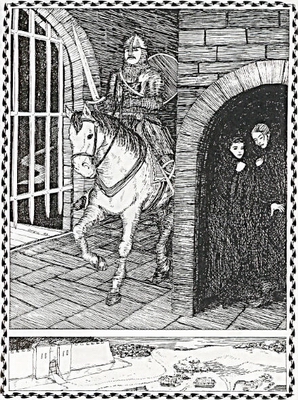 moved quietly
along the wall, past the whitewashed dairy... the granary... the brewery
with its smell of hops. The sound of hoofbeats made them both freeze. A
knight came riding through the courtyard, a sword shining in his mailed
fist.
moved quietly
along the wall, past the whitewashed dairy... the granary... the brewery
with its smell of hops. The sound of hoofbeats made them both freeze. A
knight came riding through the courtyard, a sword shining in his mailed
fist.
He rode on toward the barracks -- the two women slid along the wall, past a heavy farmcart loaded with turnips, until they at last reached the massive stone arch of the gatehouse. A sentry stood guard on the catwalk above. The iron spikes of a portcullis barred the portal.
In her bitter disappointment Lady Catherine almost cried aloud. The gatehouse was the only way out through the fortified wall. To be stopped now meant ruin for both of them. She motioned for silence and cautiously moved closer to the arch. The stones against her back were cold, but not as cold as her deepening fear .
" Ah!" she breathed. Her father's old companion Fastolf had kept his word. The portcullis had not been lowered all the way to the ground.
Lady Catherine flattened herself, face down on the ground, and crawled under wicked spikes that scratched her back through her rough garments. Phemie followed. hardly daring to breathe for fear of discovery.
Water glittered in the wide moat. A drawbridge stretched before them. a white strip in the moonlight. There were no shadows, no hiding places on that bridge. There was no going back; they had to go on. Out of the gloom of the gatehouse they stepped; two figures in black against a white bridge.
"Halt!" The sentry bellowed. and whipped an arrow from a quiver on his back. With one swift movement he notched the arrow and pulled back the bowstring.
Phemie made a move to shield her mistress with her body, but Lady Catherine held her aside. It was over, she had lost: an arrow was a more merciful end than an existence with Sir Wallis.
The sentry looked down at the two faces upturned in the moonlight. and recognized one. Slowly, deliberately, he let the bowstring grow slack. then gestured toward a design on his shield. It was a white rose.
Lady Catherine flashed a trembling smile at the man, and tugged Phemie's sleeve. "One of the few that my uncle could not buy." she said quietly. "Come... make haste."
Across the planks of the drawbridge they sped, and kept on running, into thickets of oaks and brambles that ringed the manor. She shot one look backwards at Ambermere, then turned her face forward. Her old life was over; she was running toward happiness.
They avoided a muddy cart track that led to the village. keeping instead within a tangle of brush and trees. Her mantle caught on thorns and she tore it free impatiently. Phemie held branches aside and lifted boughs to help her pass.
At the weedy edge of the thicket, Lady Catherine stretched out an arm to hold her companion back. They concealed themselves within a stand of oaks and looked out at the village of Ambermere. a huddle of deep-eaved cottages surrounded by a patchwork of plowed fields. Sudden grief choked her; it saddened her more to leave the village behind than to leave the manor itself. From childhood she had roamed every cottage, barn and workshed. The mighty smith in his leather apron had let her small hands work the bellows; sitting beside the carter she had guided the massive gray plowhorses that pulled his two-wheeled wagon.
She could hear the peep of birds. Along the roadside blackbirds mated in hedges overgrown with honeysuckle vines; once she had known the hiding place of every nest. So often she had delighted in pastures spangled with great purple spikes of loose-strife and white waves of ox-eyes. Even now she could almost smell the meadowsweet and clusters of wild roses that would open their petals with the dawn. Resolutely she reminded herself that those scenes were part of her past. There was no sanctuary now to be found in any cottage there. In the moonlight they could barely see two cart-tracks branching out from a common dotted with sheep: one leading east, one south. Phemie was so tall that she leaned down to whisper. "What's your will. my lady-lass?"
She swallowed pain and said. "We will go around the village and bypass both tracks. I left a map under my bed. marking the road to London. Let us hope Sir Wallis follows that lead. Before dawn, if we move quietly and swiftly, we should be far north of Ambermere ."
"Never fear me, I'll be as quiet as a dead rabbit." said Phemie, stoutly. Though born over the border in Strathclyde, she had not traveled north of the Solway Firth for twenty years. The route beyond the firth was vague in her memory but she recalled that the journey was difficult and perilous.
Lady Catherine sensed her maidservant's apprehension. "In a situation like this. there is but one thing we can do."
"What's that?" wondered Phemie, scratching her mop of curls.
"Our best. " She shifted the bundle over her shoulder and began to make her way toward strips of fields that encircled the village. Phemie sighed once and followed, mulling over the dauntless courage of her mistress. Lady Catherine's solitary childhood had bred in her a love of learning as well as a rare independence. Her close ties with the villagers had taught her both respect for their skills and sympathy for their sufferings. Beyond all else, her long struggle to protect her ailing father had steeled her will. That power of will was shown in her determination to reach Raven's Rock. Not many noblewomen, gently bred. sheltered from the harshness of life, would even begin such a quest. It was clear that Lady Catherine meant to see it through to the end.
**
Gray dawn found Lady Catherine wading a rocky stream, despite her maidservant's cry of protest. "Cold feet, like cold food, is bad for the digestion!"
"Never mind, Phemie, a little water in my shoes will make me grow."
They paused on the far bank, under the shelter of an ancient beech whose three-cornered leaves rustled with soft pattering drops of rain. The stream dashed on under the shadows of alders and rowans and by a grove of flowering hawthorns. She opened herself completely to the delight of morning birdsong, identifying the sweet trills of a linnet and the harsh scrape of a stonechat. Defying the rain, a brown and white dipper skimmed over the stream with a flash of swift wings.
Opening her bundle, she broke an oatcake in half, while Phernie poised herself on the streambank, fishing with a stick and a string, and giving herself instructions.
"Hold up yer point, lass. Keep opposite him... he's turned! He's comin' up! Ah! He's turned again. Gi' him no slack. Dinna let him down among the rocks or ye'll lose him. Oh! Well done, lass. well done." She hauled a dripping trout from the stream, exclaiming, "Is he no the heavy gentleman! Oh, he's a beauty. He's great." She retrieved the hook and line and tucked them into one of the many bulging pockets in her tattered garments of rust. fawn, dun and maroon scraps.
Phemie could always make Lady Catherine laugh. She drew in a breath of the cool morning, enjoying even the lowering clouds. A scattering of raindrops could not dampen her happiness. Never before had she felt so free, so unfettered. The whole world was open to her, every wonder and joy that life could bring. Under her breath she sang softly a ballad she'd heard once from a traveling minstrel. Her voice was not strong. but very sweet.
"Yellow bird.
yellow bird.
I do not ask
how long I shall live,
Or when the
summer shall come.
I ask only when
my love shall come to me."
She caught a scent of the sea, carried by rainclouds that purpled the horizon. Beyond bristling hills a storm was already boiling.
Squinting at the sky, Phemie remarked, "The wind's changin'. There'll be a lot 0' villlage folk slippin' away the now: changeable weather gathers 'em in. It's poor weather for them that are no very strong."
Lady Catherine couldn't stop hersefl from teasing her companion. "Yes, people are dying just now who never died before. "
Phemie, though, wasn't jesting. "It will be a storm over the sea. The gulls ha' been flyin' landward since daybreak. Woe is me for the poor fishermen that must bide under it!"
Lady Catherine paused in her song and an odd pang struck through her. "God guard them... " she murrured, "...the small boats, and those who sail in them."
As she gutted the fish, Phemie's mind turned to the unknown man they were traveling to meet. Ten years of Sir Wallis had lessened her respect for the nobility. She blurted, "It seems to me that we're on the brink 0' heavy times. I'm thinkin' there will be some wild stormy weather for them that lives to see it. The clouds are gatherin' over many a bit 0' sky that once looked blue an' clear."
"You worry about this arranged marriage, and Lord Alistair."
"Sorrows are our lot in life." Phemie piled a small heap of twigs and lit it with her flint-and-steel before adding a few more words of wisdom. "Ye canna ha' sweet fruit without scorchin' an' showerin' an' all the storms an' snows 0' the seasons. An' some 0' us just stop short 0' gettin' sweet after all." She frowned ferociously as she found two twigs and whittled them into spits for the fish. "But is this lord worth all yer tribulation?"
Lady Catherine lay back among the reeds, enjoying the patter of raindrops on her face. Her voice warmed.
"Don't you ever dream, Phemie? I was lonely as a child, especially after my lady mother died and my lord father fell ill. Often I would cry myself to sleep. Then it would come to me... that in truth I was not alone. Someone far away was treasuring me in his thoughts. A true friend, a brave protector. a gentle lover, who was keeping his heart safe for me. Sometimes, when I was half asleep and deep in dreaming, my spirit would sense his, as if distance could not divide us. "
Phemie raised her eyebrows in disbelief, although Lady Catherine spoke in earnest. "I've thought a great deal about such things, and I know myself. " She touched her breast, trying to find words to explain the unexplainable. "Deep in both of us there is an unawakened power to love without limit or reason, without flinching from the consequences or counting the cost. Oh yes, Phemie, he's worth it. He's worth everything. "