It was a risk to emerge from the dungeon by day, but this end of the isle was uncultivated and uninhabited. Even longships avoided this headland: the tides that battered the base of the cliff were too wild and rough. Before the castle was built, this cliff-point had given its name to the clan --Eoghain na h-Oitrich -- - the Eoghains of Otter, called so for sea otters that could be seen darting about the sharp rocks.
Jacobus shot Vincent the sort of reproachful glance that in the past had brought the younger man to heel. Sourly he had to admit to himself that his lad had moved beyond such tactics. This journey, mad as it was, showed that Vincent was considering himself a grown man now rather than merely a dutiful son.
Raindrops began to scatter; with the dawn a storm was rising. Jacobus shaded his eyes against the rain and looked across the stormy sea. Clotted storm clouds obscured the distant coastline. Just the thought of Vincent daring the waves in that frail craft brought a feeling of cold doom to the old man. He wiped his eyes with his tattered sleeve and let out a sound that was half a sob.
One last time he tried to persuade Vincent to reconsider. " All a waste, all your learning, all my care for you. Look - - you cannot even see the coast of the mainland. Is there no other way to cross?"
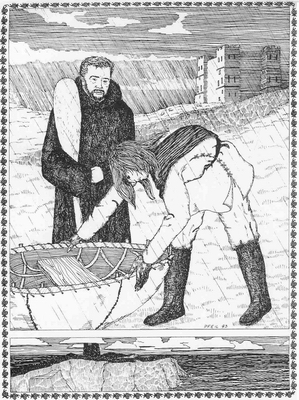
Vincent's eyebrows raised in questioning. "The Norsemen do not accept passengers, Jacobus." Then, seeing the old monk's distress, he placed the boat upside down on the grass and put an arm around his shoulders. "Do not fear for me. God will keep me safe, since it is not for myself that I make this journey. "
 "For Lord Alistair,"
said Jacobus, bitterly. "Why can he not fetch back his own bride?" In anger
he slashed at a weed with one of the oars. "You risk your life for a maiden
who is intended for another. No woman is worth such peril."
"For Lord Alistair,"
said Jacobus, bitterly. "Why can he not fetch back his own bride?" In anger
he slashed at a weed with one of the oars. "You risk your life for a maiden
who is intended for another. No woman is worth such peril."
Vincent smiled slightly; even after so many years away from the monastery, Jacobus still thought like a cleric.
"I must go, " he said gently. He tossed the plaid over the shoulder of his short white tunic and pushed both fringed ends into his iron-knobbed belt, then tucked the cuffs of his deerskin breeches into his high boots. The disguise he meant to wear when and if he reached the mainland was folded into a goatskin belt-pouch.
To cheer his old friend, he jested as he lifted the small coracle and the two oars over his head and began to descend the cliff. His boots skittered in the loose sand. Over the roar of the waves he called, "You have my permission to pray for me."
"I did not wait for your permission," Jacobus shouted back. His face twisted as he watched Vincent make his way through slippery rocks that jagged up like teeth. He couldn't watch -- he simply couldn't. Turning away, he trudged back toward the castle, so lost in misery that he didn't even feel the cold rain. It was a long walk across rough treeless country , around green quaking bogs and over hills of gray rock where sheep cropped the cotton grass. A gull drifted above him, a redshank piped from a hidden shore. Jacobus, huddled into himself with misery, saw none of it. His leg was aching badly by the time he reached the castle's outer walls, but the ache was overshadowed by the grief in his heart.
The castle itself looked as if it had risen in an earthquake from the rocky ground: sheer cliffs of gray stone and four craggy towers, above which black specks circled: the ravens of Creagan-an-fhithich. The single gatehouse was well guarded by ferocious sentries, barelegged, wearing leather tunics daubed with pitch. Jacobus halted before he reached the gatehouse and peered upwards. The entrance to the lord's tower was thirty feet above the ground, accessible only by a rope ladder. He groaned as he forced himself to climb the swaying ladder, rung by halting rung, until he reached a timber landing.
The sentry who guarded the landing wore a goatskin cap with the horns still attached. "Halt!" he shouted, and thrust out two daggers; on the curtain wall on either side of the tower, archers raised their bows.
"Don't be a fool, Somhairle," snapped Jacobus, and knocked the daggerpoints away. "Use your head, not your horns."
Reluctantly Somhairle re-sheathed the weapons: he was a deeply suspicious man with a face like a hungry hawk. "Ye're abroad early, Father Jacobus. Sayin' yer prayers to the deevil afore dawn. Ye'll be a saint 0' the dark regions afore ye die."
Usually Jacobus could come back with a quick retort, but on this morning he was too deep in misery to answer. While he waited for Somhairle to open the tower door, he glanced down over the timber railing: in spite of the rain, the courtyard below was abustle with grooms exercising horses and maidservants running carrying blocks of peat. An ox had been slaughtered; a gillie was chopping up the meat and sewing it into the bloody oxhide to form a huge makeshift kettle; under a lean-to a fIre was already burning.
Somhairle was not interested in opening the door for a priest who had sold his soul to the Enemy of Mankind. " Aw, I wouldna like to be ye! It will be an awful night when yer soul flees naked through the air toward the judgment seat, an' gets flung down again to Satan's realm, where it's all chains an' fIre."
Exasperated, Jacobus pushed the door wide himself. The tower room was crowded and noisy with talk and music; he pushed past a barefooted henchman wearing a checkered cloak and matching breeches. He was nailing pieces of leather on his wooden shield, aided by a herd-lad who held the scraps high, away from his pet lamb. In one corner Te`arlach, the bard of genealogy, and his harper were rehearsing a song of lineage, recounting all the conquests, battles, skirmishes, marriages and relations of the past lords of the Heathery Isle. With his wild halo of white hair and glaring eyes, Te`arlach did not appear entirely sane: he had spent seven years in a darkened hut, memorizing epics.
Jacobus stepped around a huddle of clanswomen who sat on the floor, on a pile of rushes. embroidering a long banner. One extraordinarily beautiful woman wore Norse gold beads twined in her flaxen braids. She sat apart from the others, embossing a pair of leather boots with Viking designs.
He shifted impatiently from foot to foot. waiting to hear the blare of a bagpipe that would announce the entrance of the chieftain. He wanted desperately to let Lord Alistair know where Vincent had gone, and why.
The screech of pipes split the air and the bannerman appeared to announce his coming. Instantly everyone in the chamber rushed toward the door, leaving Jacobus behind. He wasn't tall: over the mob he could see only the three eagle feathers in the cap of Lord Alistair .
With a sigh, Jacobus turned away from the clamoring crowd. All of them wanted something from the lord: for him to reward a new song, hear a tale of woe, judge a dispute, or approve an expenditure. Jacobus wanted nothing for himself, and yet it was clear he would not obtain a private interview on that morning.
He sat down heavily on a bench that was littered with arrows. His head dropped into his hands. All he could picture in his mind was the choppy sea and the storm clouds, and one little boat constructed of thin ribs tied together with thongs, covered with greased oxhides.
And he thought of Vincent, who had accepted his solitary fate so courageously. Unknown to anyone, he still found ways to help his clansfolk at night, with secret acts of kindness. His fearsome appearance locked him away from light and happiness, and yet his heart was gentle and rich with hopes that could never come true.
"Oh my God, " whispered Jacobus into his hands. "Keep him safe -- keep his heart safe too. Don't let this mad quest lead my lad to ruin."
When he reached the base of the cliff, Vincent lowered the coracle into the rough water and climbed in, fitting the oars to their pivot pins. The wind was northeast, blowing in solid gusts that made the water smoke. It took all his strength to row the small craft away from the cruel rocks around which the tide swirled and pounded.
He hoped that beyond the rocky reef, the sea would be calmer and that he could catch a current that would bear him to the mainland. There was something uncanny, though. about the boiling purple sky .He glanced back just once; already the headland was lost to view, hidden by curtains of rain.
A wild wind whistled, taking the tops off the waves. Lightning split the sky. A thunderstorm came up against the wind. Knives of rain slashed him - -he could only bend lower and keep on rowing. Steadily he bent and straightened, balancing the small craft through the churning sea. The morning passed, or so he guessed, when the clouds unlocked and he caught a brief glimpse of the sun. He trusted that he was rowing eastward, but it was difficult to tell.
Though squalls came swift as hammer blows, Vincent felt no fear, but only exaltation. Just to be out of that dungeon, to be fighting his way through the open sea, gave him strength to go on. He'd rotten so weary of illuminating manuscripts alongside Jacobus. copying paragraphs of Latin. adding specks of gold leaf and dots of colored ink. while he waited for night to fall so that he could wander the island. This was life.
It rained in streams, in sheets, rained solid. When he halted his rowing to bail,. the coracle dropped into a hollow between two waves. then rose again. leaping up. and spun around. Still. as he hauled on the oars again. fighting to guide the boat, he couldn't help laughing with the sheer joy of being alive and free. The violence of the wind blew the sound of his laughter away.
His exaltation faded as the afternoon darkened and the storm increased in power. There was nothing to see beyond gray ocean. gray sky, gray rain. The coracle was no sooner swept by one wave than another crashed over the side, until it seemed to be plowing under solid water. It slid into a trough and Vincent felt his stomach drop.
The coracle slid sideways down the next big wave, a mountain of water that washed over Vincent. Rowing was useless -- all his concentration and will were focused on the problem of keeping hold of the oars with one hand while he bailed with the other. He lost all sense of up and down as the boat pitched and rolled on waves as high as cliffs. Gale winds and falling walls of water strained to pull him from his place.
A wave lifted the boat and overturned it, trapping him underwater. Gasping for air, he groped for a handhold in the darkness. All he could feel was the dome above him. He sucked air when he found his head above water, then held his breath as the flood pulled him down again. Something struck him on the head.
All the power of his arms could not drag him upwards; the churning sea tore at his body. His lungs were on fIre; even death could not be more painful than this agony.
A spout of foam tossed the coracle aside; with desperate urgency he reached up and slammed his clawed hand into the leather, clutching the slats beneath. He dragged himself up onto the hull, using the power a man can use only when he knows he is dying. All he could do was hang on against the flood that tried to sweep him under .
Hours passed: vaguely he sensed that night had fallen, for the sky , sea, and rain were black and invisible. He knew he was slipping. He could no longer even feel the avalanches of water that washed over him. Even as he felt his strength ebbing away, he kept a grip on the hull with both hands.
Under his body he felt something splinter. The gallant little craft was breaking apart. For a moment he felt it was useless to fight on. Out of a despairing heart he cried aloud, "I'm going down. Protect Lady Catherine, guard her -- it is my last prayer." The roar of the wind ripped his words away.
The wreckage was torn away and he found himself swimming, still clutching a piece of broken lath. He swallowed a mouthful of seawater, choked, and sucked in a gulp of air .Somehow he kept on kicking, pulling with his arms, raising his face above the surface long enough to draw another whooping breath, half air, half foam.
There was no up or down, no east or west. There was only the hammering sea, the battering rain, and the unbending will of a man who wouldn't admit that he was beaten.
Vincent slipped in and out of awareness. His mind would drift away as exhaustion took him over, until he would startle awake to find that, incredibly, he was still swimming, still alive. It couldn't be long now. Even his great strength was failing.
The sea picked him up - - hurled him against something solid. His hands scraped sand. Somehow he moved his legs and he summoned the last of his will to inch forward. He crawled and kept on crawling and collapsed on the shore, face down in the sand.
Senseless and utterly exhausted he sprawled motionless, while the tide surged around his boots. Though rain still hammered down, he felt nothing; no pain, no fear, not even relief. In the darkness he was one more piece of driftwood on the beach.
The last gusts of the storm passed over him and the tide gradually receded. Still he lay outstretched on the sand, battered to insensibility, nearly beaten to death. At length a groan shuddered his chest and one hand moved convulsively, frightening a seabird that was pecking near his sleeve. His legs kicked once or twice as if he were still swimming, still battling the sea. He swallowed. coughed, and swallowed again. His throat burned with saltwater, and he tasted grit. Gradually he became conscious of his twisted position - his right arm bent, the left flung out to one side. Stiffly lifting his head, he saw that the retreating tide had buried both his legs in the sand. Groaning, he straightened his cramped arms and managed to rollover on his back, freeing his legs. To his astonishment, the dawn sky was yellow, with fleets of skimming clouds.
" Am I alive?"
Never had he felt so utterly amazed and overwhelmed just to be living. The sand beneath him, the sky above were the unbelievable fantasy of a world he had given up as lost.
Slowly, painfully, he got to his hands and knees. Dizziness overbalanced him and the world spun around. His whole body was an ache of agony. Little by little he crawled across the beach into the shelter of a twisted pine tree. There he rested, letting his mind clear. It was a long while before he understood what had happened. "I won," he said aloud, and a faint smile touched his bruised and weary face.
After recovering his breath he struggled to his feet, supporting himself against a pine tree as he tried to determine his position. Heavily wooded promontories and magnificent bays jagged the coastline. Above dark green islands, small specks floated; he guessed they were golden eagles. The solitude did not disturb him. He was used to being alone, and he knew that just to be alive was a miracle.
After a time he stretched, arching his back, and began one by one to peel off his sodden garments. Though every movement hurt, it was good to have the power to move and to feel, and the aches and bruises were a small price for his victory .His boots sloshed with seawater; he hung them upside down on a limb along with the linen wrappings that served him as stockings. Because there was no one to see, he shrugged off his plaid, iron-studded belt, and white tunic. His deerskin breeches, stiff with drying salt, he draped over a branch.
Never before in his life had he been able to stand naked in the daylight; there was a surprising pleasure in the momentary freedom. He released a small growl and reached his arms up over his head, enjoying the warmth of the sun and also the sea breeze ruffling the fur on his splendid body. He had never thought of himself as splendid before, but he smiled and admitted it was true. It was the power in his massive chest and long powerful legs, as well as his strength of will, that had kept him alive in the sea.
The tangle of hair that arrowed his chest was the color of wheat, while the fur on his back darkened to a light brown touched with auburn, the shade of leaves in fall. Tints of the same autumn colors glinted on his arms and legs, and in the wet mane that spilled across his shoulders. At that moment, stretching straight and tall in the sunlight, he felt not shame, but pride, as if he were a triumph of nature.
Standing at the surf's edge he twisted his tangled mane to press out the water, then combed it with an evergreen twig. With another twig he brushed sand from the fur on his legs and stomach. As a small boy Jacobus had once told him he groomed himself as carefully as a cat. At the time, he had been vastly insulted by the insinuation. It was true, though, that few islanders bathed or washed their clothing as often as he did. In the monastery the monks bathed twice a year.
Barefooted he padded down the shore, looking for mussels and birds' eggs. Returning to the shade of the tree, he found a flint-and-steel in the goatskin pouch attached to his belt, and lit a small fire to cook his simple meal. It still felt very strange to be outdoors in the daylight, and to be wearing nothing. In a way, though, he felt he was honoring his body, that had conquered the sea. Smiling at his own conceit, he traced tall letters in the sand with a stick. For a little while after he was gone, V I N C E N T would still defy the tides.
He could not stay longer on the strip of white beach; thirst was burning him. Reluctantly he pulled on his sand-caked garments. As a compromise, he carried his boots. Glancing back at the sea, now gray and placid, he knew it was not entirely for himself that he had kept on fighting. He touched the thongs of his tunic. Pinned inside, a packet of waterproof parchment cradled the ivory portrait.
*
For three days Vincent continued to follow the rugged coastline southward. Before leaving Raven's Rock he had studied maps drawn by fishermen and traders, and he calculated that two days more would bring him to the Solway Firth, which marked the border dividing the Scots from the Normans who thirty years earlier had conquered Britain. Then two more days over green hills to Ambermere. What he would do when he arrived there, Vincent had no idea: he knew only that he would not return to Raven's Rock alone.
The coastline was harsh and barren, though it had its own wild beauty .He waded across gullies so steep they sent down streams of stones instead of foam. The bare landscape was almost skeletal, the thin green skin of the earth often showing its bones: greenish slate, bluish claystones, black lava. A few junipers, pines and oaks gripped the soil where storms had not scoured it to bare rock. Although the countryside seemed bleak, the air was bright with the joy of birdsong: the shrilling of curlews and oyster catchers, the cooing of eiders, and the rough cries of herons flying in and out of their big nests in the tops of the trees.
He stayed near the cliff's edge, within sight or sound of the surging waves far below. Sometimes, however, he was halted by a chasm down which a cataract roared, and had to journey several leagues inland to find a crossing. Above him. eagles floated: once he spied a stag drinking its fill at a peat-wallow. Birds' eggs, shellfish, and wild fruits kept him from hunger, and there were flowers that he knelt to study, touching their petals with a curious finger: seapinks among the rocks, yellow flags in the damp hollows, and an occasional primrose blooming on a bank.
At night he stretched out on his plaid and watched the stars through overhanging branches. Wonderful happiness warmed his dreams. but they always vanished like mist when he awakened, leaving only bittersweet memories. Always there was that blissful sense of freedom, of being at last in the open air. The thought of returning to the dank cells beneath Raven's Rock was so unbearable that he pushed it from his mind.
On the fifth day he stumbled across his first sign of human habitation; a wooden plank painted with spirals, shoved into a heap of stones. A grave, and a recent one, for the overturned earth was still moist. Under an oak tree he came across another mound of stones, so pitifully small it had to be the grave of a child. Frowning, he murmured a prayer for the young life that had so quickly passed. There had to be a hamlet of some sort on the cliff ahead.
There was no way
around it; he had to assume his disguise. With deep reluctance he shook
it from his belt pouch: a long white hooded tunic, a square of linen with
tour ties that served as a face mask, and a small brass bell on a thong.
He tied the mask
across his face, fastening the ties behind his head, pulled up the hood
of the tunic, and slipped the bell over his head. Lastly he worked his
hands into a pair of gloves. Disguised in such a way he would be hated,
possibly even stoned, but only from a distance. No one ever came near a
leper.
He passed two more new graves before he reached the crest of a bleak hill. Below, a settlement huddled on the edge of a deep fissure in a granite cliff. One log bridge spanned the chasm. It was a desolate spot; from the look of the sunken stone huts, the settlement must have been clinging to that cliff for a thousand years.
He shielded his eyes with his hand and pondered his situation. Unless he decided to travel many leagues inland to find a crossing point, he would have to pass through the village, little as he liked the idea.
He liked it even less as he made his way down the hill. Before him loomed a grove of oaks, their twisted branches reaching to the sky like gnarled arms. He took a few steps into the shadows of the trees, then stopped short, appalled. Offerings of rags and skulls hung from the branches, turning slowly in the wind. Hollow eye sockets seemed to watch him as they turned. Under every tree lurked stark and gloomy blocks of unworked timber, rotten with age: he guessed they were images of the old gods. He felt as if he were trespassing on hallowed ground, and the ghosts of the dead would band together to destroy him. A shudder ran through him as he backed out of the grove, for his keen senses caught the smell of blood.
He wanted to turn and run from some unknown horror, but he forced himself to keep walking toward the village, though there was an empty sickness in the bottom of his stomach. Ahead rose a ring of ancient stones, topped by massive slabs. Stark and grim they stood, seeming to threaten him with their very immobility, their coldness, their silence. He was an intruder in their midst, and again he felt that sensation of being watched. Loneliness that was like an unseen presence came close about him.
Like a circle of listening gods the stones towered over a huddle of squalid huts, half sunken in the ground, their grass roofs held down by fishnets and rocks, There was apprehension in him as he walked nearer; masked and gloved, his weapons of defense were taken from him. He consoled himself with his disguise. Ghastly as it was. he trusted it would keep the villagers back.
He walked quickly down a muddy path that divided two straggling rows of huts: the village seemed deserted. Shutters and doors were all closed, and marked with scrawled hex signs. No smoke sifted up through the grass roofs: he saw no one at all. no women, no children. Something was wrong. He edged around a pile of brushwood that narrowed the path: a scarecrow of straw dangled from an iron stake that rose from its center. It was an ugly sight, and he quickened his stride, remembering tales of a time when it was not a scarecrow, but instead a towering wicker image filled with human victims, that was burned to commemorate the Solstice.
Then Vincent realized that he had been wrong: the village was not empty of life. One by one, men appeared from their worksheds. They all carried tools: a sickle, a fishing spear, a reaping hook, a heavy hammer.
He halted: through
the cloth mask he could see that his way was blocked by a two-wheeled farmcart
pulled across the path. He whirled to find himself facing a dozen ragged
men, all armed with farmtools. Spirals were painted on their foreheads.
Quietly he said.
"Let me pass ... i am a pilgrim from the Heathery Isle. I have nothing
you could want. "
A robed figure stepped forward; his shaven head, heavy gold torque, and staff twined with mistletoe marked him as a priest of the Old Religion. Lifting his staff, he intoned, "Creature of darkness. Vengeance shall rest upon thee for what thou hast done to me and mine. My curse shall haunt thee and pursue thee waking and sleeping. Thou shalt find no place of refuge in this life or through all eternity ."
Before Vincent could answer, a woman stumbled across the path, carrying a plague-stricken child. Mad with grief, she shrieked, "I seen a lion-demon in my dreams, wi' his eyes glowerin' like oily lamps, an' the slaver runnin' down his chin, an' his nostrils spoutin' fire, and his face all covered wi' blood." ,
Vincent answered
calmly. "This sickness was not brought on by me." He backed up a few steps,
judging his alternatives.
The Druid priest
shook his head and moaned. One patch of hair had been left on his shorn
skull, in the shape of a crescent moon. " Accursed one -thou hast afflicted
us with dire maladies; death shall be thine in turn. " He pointed the mistletoe
staff at Vincent and raised his other hand high, casting himself into a
deep trance. Slowly he began to chant a curse, calling on the seven gods
of the seven realms. .
His voice seemed to come from the center of his body. "Woe to thee, white lion! No more shall thy white teeth be sharpened on the bones of children. No more shall the stars turn their faces away from us. quitting their eternal tracks across the sky .In the wrath of the stars our crops have withered, our younglings have hungered and died in the fog from thy nostrils, O lion! We shall load thee with chains, demon whose breath is poison. The ashes of a funeral pyre shall transform thee. thine ashes shall be gulped down by fishes and carried to the depths of the sea. "
With his back to the farmcart, Vincent took a stand. The grief-maddened mother hurled a stone at his head, shrieking, "I see the sparks Of fire flyin' from his eyes. An' there's about sixteen other deevils at his heels."
With grim purpose the villagers levelled their crude weapons, urged on by the priest's unearthly chant and the shrieks of the woman -- - "He'll bide wit ye in the mirk o' midnight an' suck the breath o' yer soul from yer mouth!"
Vincent meant these people no harm but he was going to be forced to fight. He began to peel off his gloves. He heard a sound in the cart but before he could turn, a heavy blow crashed into the back of his head. A second blow stunned his mind like an expanding ball of fire. His sight dimmed; a nightmare swept in and smothered him in darkness.