CHAPTER THIRTEEN
Beloved Child

One by one, the days passed, each with its gray morning, gray daylight, gray dusk. The spirits did not return, for which Vincent was vaguely grateful. He was in no state to accept graciously either sympathy or comfort. As far as he was concerned, the two were welcome to stay away. If they never came back at all, but remained to serve Catherine in her new role as the wife of a great landowner, that was acceptable, too. He hadn’t been a child for a long time; he no longer needed a tutor or a nursemaid.
Wearily he climbed eight ladders to the belfry. Standing in that octagonal tower with its windows of ruby and emerald, sapphire and topaz, amethyst and beryl, amber and carnelian, he experienced a moment of extraordinary perception in which it seemed that he was aware of another time, a different reality, existing simultaneously with the moment in which he stood. The tower was still the same; he saw every detail; the motes of dust dancing in the shafts of colored light, the splintery boards of the floor, the knot at the end of the bell rope. But it was the other world that possessed his mind.
Catherine’s gown was blue, with a foam of white ruffles; she looked like a cloud in the sky. "Air is what we need," she said, pushing open a window. "Fortunately I’m not afraid of heights -- just widths." It was hard to understand why such a merry little recollection could make him wish he were dead.
He remembered then why he had climbed the ladders; and he hauled on the bell rope, four, five, six times. When the clanging echoes faded, he spoke through the colored glass windows as if Mary and Jacob could hear.
"That was not a summons. I don’t want you to come back. That world of seasons and snow and rain and stars was yours, before Anya claimed you. I give it to you again. Be happy." He meant it, but he was talking only to himself. He fell into that habit quite a bit, these days.
*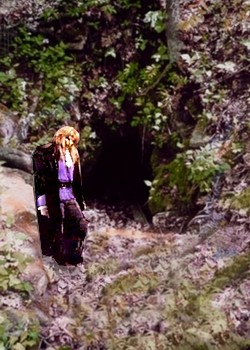
The castle seemed so dreary that he spent most of his hours on the other side of the river, in the grotto he had constructed as a boy. A silver lace vine concealed a cleft in the rock. The narrow tunnel beyond was taller than a man could reach, but the silence and blackness were so complete that it was difficult to walk upright under the intangible pressure of the rock.
The tunnel wound on for nearly two hundred feet in utter darkness. Vincent kept one hand on the wall, feeling his way and counting his steps. A faint lightening of the gloom led him on to a round chamber illuminated by a dusty glass skylight, half obscured by fallen leaves. As a boy he’d been very proud of that bit of construction. To enhance his solitary games, he had furnished the round cave with a cot and a table. The furniture had long since rotted away, but coats of arms he had painted around the walls still kept their shapes and outlines. Four great piers of rock led into four tunnels; two exits and two that led into deeper hidden holes.
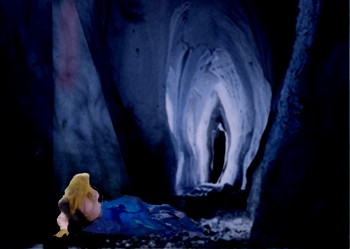
There was a certain peace in the close darkness he couldn’t find in the open air or the rooms of the empty castle. There was one narrow tunnel that felt like a grave. Lying there in the darkness, surrounded by damp earth, he could pretend he was dead -- that he would never feel anything again. No clawing grief, no crushing loss, no heartbreak. It was peaceful there, under the hill, when he could make his mind go blank for a little while. Mary would never have let him get away with that; she would have sought him out. So that was another reason for being relieved the two were gone. He was perfectly, totally, utterly free to do whatever he wished. If he could only think of something he wanted to do.
When hunger gnawed him, he made a sweep of the great hall and
discovered a bowl of fruit and a platter of bread. He took them back to the
grotto, along with a tattered wall hanging of mermen and dolphins to serve him
as a sleeping mat. It was thin and the nights were chilly, but it suited him
better
 than the bed in the castle. Wrapped within the tapestry, he slept
lightly, in fits and starts. Sometimes he was wakened by the fall of a twig or
the rattle of a stone.
than the bed in the castle. Wrapped within the tapestry, he slept
lightly, in fits and starts. Sometimes he was wakened by the fall of a twig or
the rattle of a stone.
He was usually relieved to be startled awake, for his dreams were appalling. Every night, always the same dream.
There was a rocky desert, and a cage covered with blowing sand. Nothing could be seen under the dune but a skeleton hand clutching the lock. Far in the distance, it was raining, refreshing the parched earth. A caravan moved through the rain toward a green oasis.
He sat up with a gasp, his body soaked in sweat; and knew the nightmare was true. Life was moving away from him toward a green land on the far horizon. He was caged forever; no one would ever release him. And yet even in his darkest hours, when isolation closed around him and he lay shivering under the weight of indestructible, ceaseless, neverending loneliness, he never wept. He was hurt beyond belief; beyond the easy release of tears. They gathered in his chest like drops of lead and weighed him down until he could hardly move.
It seemed fitting that he should be living like a beast, scavenging for food and sleeping in a cave. Beasts lived moment to moment, without hopes or fears. He had nothing left to fear, and hopes were for men, like Gunther.
*
Weeds roughened the grass and sprouted in the flower beds. Snowy roses bloomed and withered in the alcove under her balcony. When he felt a spurt of energy he tried to tend the lilacs and the wisteria, remembering how she loved them; but after a while, there didn’t seem to be any point.
"Catherine won’t see them. She has flowers of her own at home. Hollyhocks, irises, and pansies. I recall quite well her saying that." But he couldn’t take much credit for remembering. The days they had spent together were so few it wasn’t difficult to keep things straight. He went over their time together in his mind meticulously, reproducing their conversations in the gardens, the library, the great hall. There was always the secret terror that some phrase or expression or turn of her head had escaped his notice. The moments he couldn’t recall were lost forever, and he wanted to keep every one.
One afternoon when shadows were long, he pushed the massive gates open, flattening spike grass that was beginning to sprout in the avenue, and took a stand outside. Lifting his head, clenching his fists, he tried to get a sense of her through the connection that once had been so strong. He opened himself inwardly to any faint vibration.
"Can you hear me, Catherine? Once your name-song led you through the forest to these gates. Won’t you let it lead you back again? Come back and race me down the painted ladders. Sit beside me on the flagstone steps and tell me it was all a mistake. Lose yourself in the maze with me. In one of those corners between the high green walls, a kiss might happen, and then you would know I’m yours forever. If you have a wishing well at home, look into the water and see me now, standing here alone, aching for you."
Despite his straining efforts, nothing came to him. Her emotions, her thoughts, even her whereabouts were entirely beyond his reach. Perhaps the forest-magic was too strong, and blocked any messages. Or the barrier did, if she was safely home. Or perhaps the bond had been broken by new dreams ... a new and happy life.
He came back inside and pushed the gates shut. The spike grass would soon grow up to the hinges again, as if they had never been opened.
*
He stood on the ivy-covered bridge, looking out at the river and the stand of willows beyond which her boat had sailed. Morning mists were lifting from the river. He was glad, now, if he could be glad about anything, that he hadn’t spoken his heart to her in the ballroom. Catherine had a generous nature, and it would have hurt her to hurt him. She had departed without knowing; and that was best.
She was home by now, reunited with her other sister and with her friends. When the villagers came and begged her to recount her adventures, she would say it wasn’t so bad there. Yes, there was an enchanted castle; and yes, there was a beast, but he was bearable.
He tossed a sprig of ivy and watched it float away. Well, the tale was almost true. Leaving out a few incidental details, such as a rose that blushed red, and a kiss that never happened, and a dance that ended too soon.
The bowls of potpourri she had made for the great hall gradually lost their fragrance and dried into brittle crumbs. The vases of flowers withered and blackened; he tossed them out, then returned and tossed the potpourri out, too. The fireplace was cold. He leaned against a dining table; dust outlined his handprint. His high-backed lion chair and her chair of blue brocade had been pulled away from the table by Charles and Gunther and never pushed back. The dangling wheels of candles had all burned down. It wasn’t worth while lowering the chains and replacing the stubs. He didn’t intend to have any more meals at that table.
Her embroidery hoop, a pincushion, and a handful of silk threads scattered a window seat in the recess. She had never completed her map of the village.
For some reason the unfinished embroidery enraged him. Perhaps it was the word itself, ‘unfinished,’ that rang in his mind like a death-knell. He knew, though he didn’t want to admit it, that some of his misery came from anger. It didn’t have to end so soon. All this agony wasn’t necessary. It wasn’t Charles or Rebecca or even Gunther who had torn out his heart, but Catherine herself. She had chosen to go. Just because they knelt and begged her. He could have done that, but he didn’t want to distress her.
"If I had knelt and pleaded, it wouldn’t have made any difference. She’d made up her mind already. She missed the apple tree outside her window. She missed the kitchen cat."
The leaded glass windows had been shattered by the last earth-tremor. He threw out the hoop, then the whole handful. Anger ran through him like a sheet of flame.
"Catherine, you didn’t have to go. They couldn’t have forced you into the boat, if you had wanted to stay. You could have spurned the man in crimson satin and put your arms around me and said ... "
He stopped, choking on his own words. He didn’t know what Catherine might have said, if she had loved him. He’d read many declarations of love, in poems, but they were all in rhyme. Catherine’s declaration would have been real. If it had been real. If it had ever happened.
He sat down at the dining table after all, reached out his arms, and dropped his head, fighting against the brutal intensity of his hurt. He was breaking apart inside.
There was only one sanctuary where he could escape from the crushing burden of loneliness. To find it he retreated deep within himself, to a place where happiness lived. There he had built a shrine in which his charming guest was enthroned. It was to her he had brought the books he read, the ideas and feelings that moved him, his dreams and visions. It was in his imagination that his real life had taken place, while the scenes of his daily routine passed almost without notice. Once vague and insubstantial, his dear companion now had eyes that were deep pools of green, shaded by soft lashes. Laughter lurked in the curves of her red lips. There was a wealth of character in the moulding of her chin that would have singled her out in any company.
‘Tell me of your day, my love.’
‘It’s been such a bustle, Vincent, arranging everything for the dance. Laura and Rebecca are helping Mary and Jacob. All our friends from the village will be arriving soon. Tell me -should I wear the sky blue gown, or the sea green?’ •
‘You make every gown beautiful, Catherine, but I would say ... the sea green. I trust you will save the last dance for me?’
‘Every dance, always. No other man will ever hold me, not while a harp is playing.’
‘You’re my soul, Catherine. When you touch me, I live. If you should ever stop loving me, I’d die of grief.’
‘Oh, Vincent. That could never happen! I’m yours -- yours -- yours.’
Slumped across the table, he wondered if he might be going mad. It was possible, he thought. But it didn’t really matter. If madness allowed him to believe that fantasy, it might be worth it.
*
It seemed to Vincent that nothing ever again would be certain. Not only had his inner world been shattered but the familiar objects of his world no longer had reality. The marble statues in the library, the faded gold stamping on the leather-covered walls, the half-finished volumes on the long table; all seemed insubstantial, as if they would disappear at his touch.
He opened a book at random; it showed a drawing of a hell-doomed wretch staggering back into a pit of smoke, while angels pulled up a ladder to which a luckier sinner was clinging. The one being pulled up to paradise had long black curls and a handsome face. He couldn’t recall the rest of the tale, except that the lucky fellow deserved his reward and that the punishment of the other was justified.
To be given a glimpse of paradise and then be left behind -- that was too cruel. He ripped out the illustration and dropped it on the floor, then tore the book in half and threw it aside.
That one was finished, but there were many other books that still needed rebinding if he could make the effort. He rearranged his tools along the length of the table. Under a bloodstone burnisher he found the journal she had made.
"Sixteenmo," he said quietly, opening the marbled paper cover. On the inside was written, ‘For Vincent, from Catherine. To record the events of every day.’
Turning it over in his hands, he considered leaving it blank. Nothing more would ever happen. All his events were in the past. A sudden thought brightened him a little. Now he had a way to record their conversations, while they were still fresh in his mind.
Immediately he sat down, clearing bookbinding materials from the table with a sweep of his arm. He dipped his quill pen and began to write.
"It hurts ... Who is there? I can’t see you."
"Please don’t be afraid. No one will harm you. You are safe here."
Many hours later, he closed the booklet and worked his cramped fingers. As he rose to go, he noticed Catherine’s shawl thrown over one of the chairs. It was palest yellow, crocheted in shells. He had folded it around her shoulders once, and let his hands rest on her bare skin, and she hadn’t minded. That fleeting touch was a caress, and she hadn’t objected. The memory was not so much in his mind as in his hands, that still remembered the smooth curve of her shoulders. All he would ever know of bodily love was in that touch. His whole body ached with the recollection.
He climbed a single flight of stairs and folded the shawl over the handle of her chamber door.
Since first bringing in armloads of books and painting silver stars on the ceiling, he had not crossed the threshold. If he wanted to, he could go in now, and see her rainbow of gowns hung in the wardrobe, and her nightdress thrown across the bed, and the red and white rose in its silver cup. If he liked, he could even take his former place at the breakfast table on the terrace and pretend she was sitting across from him. She wouldn’t mind if he took the room back now. She’d never even know. Neither would Mary or Jacob, who had obviously chosen the world outside. He had no need to be embarrassed. After all, it was his castle.
Lightly he stroked the carved roses and the letters of her name. Then, without opening the door, he turned away. The chamber was hers. Let it remain hers, until the last of Anya’s magic faded, and the castle crumbled into ruins.
For him, there was always the grotto. Face down on the ground, wrapped in the tattered wall hanging, he let a whole day pass, ignoring the movement of faint sunrays through the leaf-covered skylight. He was crushed by the life he hadn’t led. Would never lead.
*
Pretending to be buried lost its power after a time, and he tried exertion, hoping it would reconcile him to his fate. Beginning at the lion gates he followed the castle wall, striding swiftly eastward in an attempt to leave misery behind. A thorny tangle of ilex, nettles, and burdock stretched for leagues along the base of the wall. A few square stones had been shaken down by the last tremor; already they were overgrown. White haze drifted in from the forest.
Limes and beeches mingled their leaves overhead. Espaliers of apples, plums, and apricots clung to the black stones. One of Mary’s projects. He ate a handful of plums as he passed.
He was halted briefly by the river, which poured on into the wood through a round hole in the wall. He waded until the riverbed dropped and the water was deep enough to swim across. Climbing up to the bank again, he removed his shirt and wrung it out as he walked. There should have been some pleasure in walking barechested in the open daylight, but he couldn’t summon any emotion.
Night fell, draping the trees in damp and chilly fog. He shrugged his shirt back on but did not stop to rest. Gradually the wilderness took over and the landscape changed to rugged hills and wastelands choked with brambles. Anya had provided him with a large estate.
The following day he reached the halfway point and swam the river for the second time, where it entered the grounds through a gap in the wall. This time he didn’t bother wringing water out of his clothing. It would dry as he trudged on. Looking through a wilderness of shaggy trees, he caught glimpses of the back of the castle. It was constructed in a heavier manner than the fret-work turrets that spun upward in front. The back resembled a mountain range, with cliffs, peaks, and rocky barricades. Clouds hid the pinnacles.
"Anya must have run out of time before she could finish the back."
A day later, as he rounded the cracked mermaid fountain, a thought came to him. He pulled his sleeves down over his hands and put his shoulder against a purple boulder that thrust up from the grass. He heaved mightily, then pushed again. The boulder toppled, revealing a patch of tinted earth. Sparks flew up like stinging frost. With his boot he scraped the earth until he uncovered a grimoire bound in snakeskin with a serpentine brand on the cover. It was Anya’s own book of spells.
He sat on the rim of the fountain and balanced the book, thinking deeply. Red drops seeped out from the cover and splashed on his boots. It was his own blood that had been dripping from the binding since his arm was caught. Holding the book made the unhealed scar ache badly.
He traced the design with one finger as he considered prying open the binding. The serpent wriggled slightly at his touch. There just might be a spell he could use either to lift the dome or to win Catherine’s love and bring her running back to his arms.
It was a temptation -- he was certainly wretched enough -- but even as he considered the idea, he knew it was no use. He couldn’t read the simplest spell -- they were always written in runes, which he could not decipher. Jacob and Mary had refused to teach him any magic when he was a boy, knowing he had no natural powers. And now it was too late.
Even if they should return and help him lift the dome, it was very likely he couldn’t survive outside the sphere of magic. At the moment, he didn’t care too much about living, but destroying himself wasn’t any sort of an answer. As for the other spell he had in mind, a charm to bring her back to the castle …
Her family had accused him of casting such enchantments. At the time, he had denied it fiercely. Though his need was greater now, he knew that to gain Catherine’s love by sorcery would be a betrayal of her trust. Besides, his heart would know it wasn’t real. If he could beguile her into speaking words of love, he would only be talking to himself.
"Your path is yours to make, Catherine. Whatever you want, I want for you."
Finally, with a sigh, he put Anya’s Book of Shadows back in
the hole, cove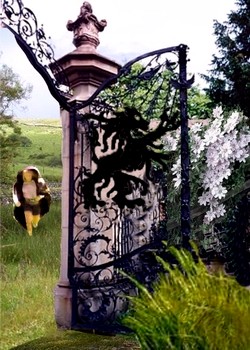 red
it with dirt, and left it behind. He didn’t bother to replace the boulder. If
the book wanted to explode, let it. Walking steadily, rarely halting, he covered
the last leagues of the journey.
red
it with dirt, and left it behind. He didn’t bother to replace the boulder. If
the book wanted to explode, let it. Walking steadily, rarely halting, he covered
the last leagues of the journey.
The clematis vines that matted the wall were just the same, white as snow. Everything was just the same. He leaned, stiff-armed, against the lion-gate, and wondered what his circuit had accomplished. Within himself, nothing had changed. His unspeakable grief had traveled with him every step of the way.
He repeated his own words, "Whatever you want, I want for you," and knew it was not true. With every hour that passed, the path she had chosen was carrying her deeper into her own world. Not to his open arms. Not to a chamber with oriel windows that overlooked a circle of rosetrees, and a maroon-draped bed.
He would never see Catherine again. By her own choice, she was lost to him forever, and he was fated to live and die alone. His mind grew black and the daylight seemed suddenly filled with the redness of fire. He hadn’t known that he would suddenly find himself overwhelmed by a rising wave of unbearable woe. He gave a gasp that tore at the muscles of his chest; then drew in a great breath, threw back his head, and howled. It was a cry of madness itself, a wailing and terrible howl that began as a sobbing moan and grew in volume until it seemed to fill all space. It died away at last in a plaintive sob that lost itself in distance.
His legs folded and he sank down to the bottom of the gate, tearing long gouges in the wood with his nails. He had to control himself from beating his head against the gate. She had been so gallant, so lighthearted, so dear. Only grief and silence remained. The wave rose and broke and swept him with it. Kneeling there, collapsed against the gate, it was beyond his strength to hold it back. There was nothing he could do against bitter helpless sobbing that went on and on until he ceased to make human sounds. He screamed like a tortured animal until his voice was a thread, but it didn’t matter. There was no one to hear.
*
In the great hall, propped against a high-backed chair, he found his lute. He touched the strings, which were no longer in tune. The faint discordant sound brought back happy memories that were unbearable now. Playing to Catherine as she sat with bandaged eyes, looking so forlorn in her linen nightdress. The music itself, so much deeper and wilder by the time it tumbled across the strings of the harp. The passionate music might have turned every white rose to red, if she had stayed. That song would never be written now.
For a little while, he had found the center of life, the point from which all happiness radiated. But Catherine was the center, and when she left, his life went with her, like a creature in a fairy tale whose heart was not in his body, but hidden in a faraway secret place.
Touching the lute, he said, "I miss you. I miss you! Catherine, I miss you so much. Come back. Come back!"
It was a cry from the soul, and he waited for an answer, but her spirit sent him no message.
He laughed harshly, mocking himself. "Why should I expect it? She’s too far away. Probably the bond existed only in my imagination -- I let it run away with me sometimes."
She was just a recollection now, a vision from the past or from the realm of daydreams. The tenderness and trust, the laughter and companionship survived only in his memories. "It would be enough," he had said to her, there at the end. But there wouldn’t be any more memories, and they were not enough. No matter how he treasured them, they were pale things that would fade in the endless years to come.
"I was luminiferous once, but not for very long."
He picked up the lute and carried it outside. Walking eastward across the weed-choked lawn, he played again the chant for Anya, the lullaby for Mary, the counterpoint for Jacob. But not the name-song. There were limits to what he could bear. Even the journal that recorded their conversations in such detail stopped before the dance. Before that night in the ballroom, there was hope. He would remember that far, and no farther.
The lake was a sheet of steel that reflected perfectly the drooping oaks and willows around its rim.
"A faraway secret place."
Vincent whirled the lute over his head like the sword of an ancient king, and threw it far out in the lake. The sheet of steel was broken, and the willows quivered.
*
He couldn’t go on any longer. He had managed to survive without companionship before she came into his life, but his desolation was deeper now. Before, he had read about love only in books. Now he knew what he had lost.
 At the end of his strength, Vincent climbed the stairs to his
own chamber. The somber draperies and black quilt were just the same. A layer of
dust filmed a volume of love poems and a chess set. He threw the book into the
fireplace; a narcissus fell out of the pages. An angry sweep of his arm sent the
chessmen flying across the floor.
At the end of his strength, Vincent climbed the stairs to his
own chamber. The somber draperies and black quilt were just the same. A layer of
dust filmed a volume of love poems and a chess set. He threw the book into the
fireplace; a narcissus fell out of the pages. An angry sweep of his arm sent the
chessmen flying across the floor.
He paced the chamber, gripping his head with both hands. There wasn’t any escape from his craving. He wanted her so badly he could cry. To finish the match ... to share those verses … to lie beside him and pull together the bed curtains, enclosing the two of them in their own little world. She had slept in that bed. She never would again. Maddened by broken hopes, he kicked the gryphon andirons, raising clouds of ashes.
Violently he knocked a candlestick from the mantle. He didn’t intend to light any more candles in honor of Anya. Once he had thanked her for his life. Never again.
Out of a despairing heart he cried aloud, "Mother, why did you let me live?"
He ripped the portrait down from the mantlepiece and shook it ferociously. The woman wrapped in lightning could not aid him -- she had been dead for centuries. He hurled it against a bookshelf, knocking down a folio.
Bracing his arms against the windowsill, he stared out into grayness. Gray clouds -- gray trees -- that was all. Every morning would come with a gray sunrise and pass into black that was only a darker gray, like his empty life.
"From across the gulf of time I answer you, my beloved child"
He whirled and fell back against the wall, staring at the portrait. Painted eyes looked into his, and painted lips moved.
"You have cursed me for the dome of magic, but my own death is approaching, and you must be protected. You were created to be sacrificed, and I am ashamed of that intention, but not of you, my son. You are dear to me – to Anya the sorceress, to whom no living being has ever been dear.
The fated hour has come -- your destiny hangs in the balance, and you cry out to me, your last recourse. In my Book of Shadows Catherine's name is entwined with yours. Win her love and my guardianship will be ended. This is my last, best gift to you."
The eyes of the portrait fixed again, and the lips froze.
Gasping, he begged, "What are you telling me? Win Catherine’s love? She’s gone -- gone forever." In desperation he shook the frame again, to no avail. The message prepared so many centuries before had been imparted, and the power had gone out of it.
Down the stairs he ran and out into the courtyard. Near the circle of rosetrees he halted, maddened by hope and despair. What did the message mean? How could he reach Catherine -- she was so far away.
Standing there with his fists knotted, Vincent made his decision.
"I will follow the river and find her in the village, and offer her everything I have and everything I am, and ask for her love. If she refuses, and the villagers slay me, then let it be so. If she loves me, then ..." He didn’t know what might happen then. He couldn’t think that far ahead. Whatever happened, he would see her one more time, and speak the truth of his heart, before he died.
Once the decision was made, there were no second thoughts.
He ran down the avenue and pulled open one of the great creaking gates. He took
a few steps into the forest and looked over his shoulder; the gateposts were
still visible, but already the towers were hidden in mist. There was a piece of
bread in his pocket; that would have to do, for he would not turn back.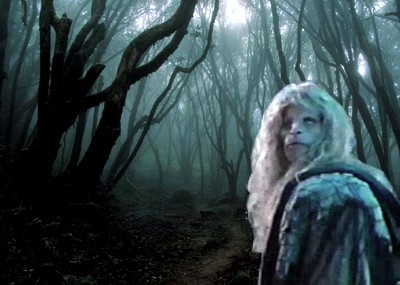
The branches of the trees were antlers wreathed in fog. The gray earth was barren. He followed the cold rumble of water and found the river where it emerged through a hole in the castle wall. Catherine had braved that sullen river in a small boat to return to her own world. He had no boat, but he had something more crucial. An absolute determination to see again the face that shone in his heart.