CHAPTER SEVEN
Homesick

Gray had not yet begun to streak the black sky when Vincent ran down the entry way steps and across the courtyard. He was filled continually with one thought, he rebelled against any obstacle in the path to one desire, and from morning until night he was impelled by one eagerness. A rampart of box-hedge rose before him, blocking his way; the small wicket gate was rusty, and reluctant to open. Wild with impatience he pulled harder; the hinges loosened and he stood there with the gate in his hand, feeling like a fool.
"Easy, easy," he cautioned himself, tossing the gate aside. "She hasn’t even arisen. Give her time."
He forced himself to walk through the maze, rather than run. In the center he came upon the vine-covered summerhouse. Only a few days earlier, Catherine had been with him there, before the incident of the wishing well had shattered their comradeship.
He lingered under the summerhouse for a little while, trying to cool his impatience at least until sunrise lightened the sky. But the memory of how Catherine had leaned over her balcony and invited him up was too powerful. All his thoughts were blurred and colored by the overwhelming emotion she aroused in him, the hunger for something just out of reach. Longing drove him through the other turns and corners of the maze, and into the second garden.
Even in darkness, the flowers gleamed eerily, for all the plants in this enclosure were white: shrubs, trees, and blossoms. Arches of drooping wisteria looked like ghosts of themselves.
He pulled straight his dark blue doublet; then paused for a moment to catch his breath and steady himself. A hand went to his chest to calm his heart’s wild beating. "Wait, wait, be calm," he told himself. "It’s very peaceful here. Serene. You must be serene."
In his mind he could see it all. Soon the diamond-paned doors would swing open, and she would come out, dressed perhaps in yellow, like a ray of the sun; and he would feel his own life awaken.
‘Up so early?’ she would tease him. ‘You’re a very hard-working gardener.’
He had learned to answer with a jest. ‘Yes, and I exercised the goats and groomed the cows and milked the horses.’
‘You must be hungry, then. Would you care for some breakfast?’
‘I suppose I might nibble a scone or two. If you insist.’ He would climb easily up the ivy-covered wall, and there she would be.
He couldn’t wait any longer. As he put his hand on the gate, a breeze spun around him; a stick scratched the earth.
"I’m sorry, dear; she let us know she doesn't want any breakfast."
His disappointment almost staggered him. "Oh. Well, then, I ... then I suppose ... "
"Vincent, she’s ill."
His breathing stopped; for a moment he thought his heart would, too. "Ill?"
"With weeping. She’s worried about her father and her sisters."
"I know that," he managed to say. "I know she worries. She is deeply loyal to those she loves. Tell me, Mary, is there anything I can do?"
"Perhaps tomorrow, if she feels better."
"Tell her -- just tell her that I’m here."
Mary couldn’t bear to see him so distraught. "Vincent, don’t take it so hard. You believe you love her, but it’s just your long loneliness, really."
He waved her away. "If her sisters had come with her, I would have become fond of them, but no one could draw the soul out of my body as Catherine has done."
"I hope so desperately you won’t wake from your dream and find only sorrow."
Despite his misery, he wouldn’t heed her. "I’ll accept dreams or reality, whichever has her in it. But I repudiate utterly any version of sleeping or waking or living or dying that doesn’t have Catherine as the center."
Before she could say anything more, he turned and walked slowly back through the white flowers. Gray dawn had come at last; it was no grayer than he felt.
Mary wiped her eyes on a corner of her apron. Some of the tears were for Catherine, too, who would never hurt him intentionally. She just didn’t understand the power she had.
Jacob came from around the corner to join Mary in the garden. The elderly phantom was rather prudish, and didn’t like to enter a lady’s bedchamber.
He raised one finger in an oratorical gesture. "I heard it all. This woman is bringing him nothing but unhappiness. We must explain that there is a way through the forest, so that she will return to her own home and cease to plague him."
Mary exploded and went after him like an avenging angel. "Whose side are you on? If you imagine Vincent would simply forget about her, you are more of a fool than I thought. You whisper one word to either of them and I’ll never, never, never speak to you again. I mean it, Jacob!"
Taken aback, Jacob fended her off with both hands and retreated into a corner of the arbor. "I entreat you to be calm."
Mary followed him; she wouldn’t let him hide. "I refuse to be calm, and don’t you dare tell me that women should cultivate self-restraint. I’ve put up with you for the last several hundred years and that’s taken a great deal of self-restraint."
Jacob took refuge behind a birch tree. "If you are determined to keep her here ... "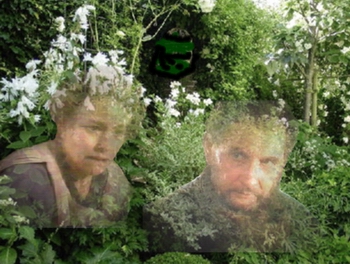
"I am determined, and you’re going to listen to me. This time I’m putting my foot down."
Jacob knew when he was beaten. "Since you are so adamant, I will say nothing, though it is technically an untruth."
Mary crossed her arms and glared at him.
"I’ll know if you do," she said grimly. "So don’t imagine you can give either one of them any hints. You know Vincent by this time. If he were to recall that the river flows through her village, he’d row her back to the edge of the forest and then return to the castle alone and crawl into his grotto and grieve himself to death. Is that what you want?"
"I’ve already surrendered my principles," Jacob protested, throwing up his hands in defeat. "My stainless integrity is gone; I’ve joined the ranks of those minor thinkers who care nothing for morality."
"That’s fine, just keep it that way," said Mary.
***
The lake was a sheet of silver reflecting drooping trees. Vincent sat
for a while on a low broken wall lined with lion masks. The ivy that clung t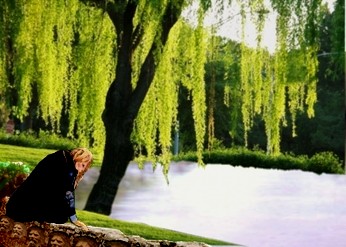 o
the keep looked dank and cold. White lilacs flanked the open door. There was
nothing to do, no way of passing the time but by thinking of Catherine. He
might as well give himself to his unhappiness, he might as well think of her,
ache and long for her. Anything else was a denial of reality.
o
the keep looked dank and cold. White lilacs flanked the open door. There was
nothing to do, no way of passing the time but by thinking of Catherine. He
might as well give himself to his unhappiness, he might as well think of her,
ache and long for her. Anything else was a denial of reality.
Inside the keep there was a smell of rotting hay. A pony’s mouldering saddle hung over one of the two stalls. Time had almost erased childish writing on the stall door: ‘Charger.’ He traced the word with his finger. Charger had been his own pony when he was very young, and the castle bustled with maidservants and cooks and stablehands and gardeners. The pony had been his best friend. But animals did not thrive under the dome of magic, and despite all that the stablehands could do, it sickened and pined away. His horse was not the only creature that did not thrive. In the beginning the lake and the lilypond swarmed with fish, and the trees sheltered hundreds of birds. It wasn’t long before they, too, were dead. It was even possible that the servants themselves hadn’t survived as long as they would have in the world beyond the wood. Anya’s magic, though unbelievably powerful, was not benevolent.
Absently he stroked a stirrup strap. The leather was so old that it crumbled at his touch and he was left holding a ring of tarnished brass.
He’d meant what he said to Mary, but a ghastly possibility had to be confronted. Would Catherine, too, lose strength and fade away if she stayed? If so, he would escort her on foot through the forest all the way to the barrier, even if he had to battle his own mother’s magic every step of the way.
"I’ll see you safely through, Catherine … ask me, and I’ll do it. And if you knew what losing you would do to me, you’d know what it’s costing me even to suggest it."
His throat closed; it was hard to breathe. After a long moment, he left the keep behind and made his way back to the castle.
He roamed aimlessly through the empty rooms, trying to think of a way to help her, in vain. Chess and music had cheered her when she was sightless, but they wouldn’t distract her now. It wasn’t amusements she needed. She wanted the people she loved. She wanted to go home.
‘She wants to leave.’ He could hardly utter the words in his own mind. It would mean the death of something in him, as if he might never be the same man again.
He found his old place in the window seat in the great hall. Her hoop and embroidery threads littered the cushions. With one finger he outlined the design she had begun ... scattered squares that resembled houses.
"How could I expect her to be happy here. I can push her in a swing ... that’s all. She wants a life, with friends and other people. She’s been so brave, and now it’s my turn to be brave for her."
He rose from the window seat and wandered outside again, eventually ending up at the lake. He untied a small boat and rowed out to the center, hoping to find peace in the gentle rocking of the water. But there was no peace to be found.
Long hours passed in misery as he slumped on the wooden seat. He fought to control his thoughts, to no avail. Each time he looked toward the castle, he wondered what was happening in that room with the silver stars painted on the ceiling. Every time he glanced toward the keep, deathbed scenes came back to haunt him: kneeling by Mary’s bedside as she breathed her last; stumbling over Jacob, dead in a hallway. He remembered a cook whose rosy face grew waxen. She coughed blood before she died. There was a gardener who had clutched his ribs and fallen and never risen again. It was in the hawthorn grove they found him.
"One cough, one pain, and she’s going home, even if I have to carry her in my arms all the way."
When the afternoon began to fade, with no word from either of the spirits, he rowed back to the shore, tied the boat to a willow tree, and made his way up the avenue. Faint lights gleamed through the trees, but he couldn’t distinguish her window. All he could do was speak her name, over and over; the name itself was a prayer. "Catherine. Catherine."
There was a book of ballads on the steps; he couldn’t remember when he’d left it there. Sitting down, he tried to look at a page, but the words were a blur.
He sat with his head in his hands, wondering, when he could think at all, what would happen after he returned through the forest alone. There would be nothing to look forward to but endless years of imprisonment. A few pleasant memories were all he had; moments in the summerhouse, the belfry, the terrace -- Catherine sitting on the edge of the mermaid fountain and standing under arches of wisteria.
"Those recollections ought to be enough to survive on, but they’re not. This little light, and then the night."
The sound of a step startled him, and he turned abruptly. Catherine stood in the entrance, looking like an angel in a soft white gown. Like a feather from a dove’s wing she floated down the stairs. Violet shadows hollowed her eyes.
"I -- I thought some air might do me good," she began.
Vincent was so broken by anxiety that he didn’t think to ask permission. He simply lifted her in his arms and began walking.
Startled at first, Catherine gradually allowed herself to rest against him. He was so strong that it gave her a sense of safety to be carried ... just this once. She didn’t even ask where he was taking her. Instead, she closed her tired eyes and leaned her head against his shoulder, hiding her face in his tangled mane.
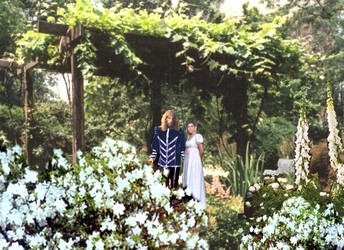
As he walked downhill with Catherine in his arms, he was fighting ten battles with every step, driving himself deeper into agony. Somewhere nearby, a waterfall splashed. She felt the coolness of shade, then the warmth of light, then shade, then light, over and over again. It was in a place of coolness that he finally stopped. She opened her eyes and saw overhead a trellis of grapevines, heavy with dangling fruit.
There was a curved bench of stone; there he found places for them both. He took off his cloak and wrapped it around her. In perfect trust she leaned against his shoulder. They both were quiet for a long time, for different reasons.
 In a broken, heart-wringing voice, she said, "This is a peaceful spot."
Stone goddesses were tucked into niches in a semicircular hedgewall that
supported half the trellis; wooden pillars held up the other side. The grass
was deep velvet, sprinkled with fallen grape leaves.
In a broken, heart-wringing voice, she said, "This is a peaceful spot."
Stone goddesses were tucked into niches in a semicircular hedgewall that
supported half the trellis; wooden pillars held up the other side. The grass
was deep velvet, sprinkled with fallen grape leaves.
"My favorite place," he said at last. He didn’t recognize his own voice.
After a moment, she tried to explain what she was feeling. "Until you carried me here I was so lonely. At home there was no loneliness anywhere. The world was full and shining and warm. We wanted nothing but each other. Last night and this morning all I could do was remember, and it seemed as if the remembering was killing me over and over again." Her voice trailed away into bitter helpless crying.
She tried to hold back her sobs, but the small sounds she made were so pitiful that Vincent very carefully put his arms around her, saying, "Just let yourself cry."
Her head bumped his chest; her hands twisted in his doublet. Holding her, Vincent pressed a kiss into her soft hair, so lightly that she didn’t feel it.
Between sobs she mumbled, "I’m not usually such a baby."
"You’re the bravest woman the gods ever put on the earth. And you have much to endure."
Something of his steadiness and strength flowed from him and gave her the power to sit up straight and wipe her eyes. "You’re kind to me, Vincent."
He lifted her fingers to his lips and then held her hand against his chest. "If I were kind to you for a thousand years, I could never give back to you what you have already given me. More than I ever thought I deserved."
She didn’t know how to begin. "I’m afraid that vision in the wishing well upset me quite a bit. Knowing they’re mourning for me."
"Yes, I know." She was looking down; he could only see the top of her head. But then in the dusk she couldn’t see his expression either, so perhaps it was best.
"I think about the geese flying over in the spring and my own chamber with its ewer and basin, and the kitchen cat, and Rebecca’s wedding, and my own hopes for a happy life, and it hurts me so much to know I’ll never see it again.
"I know. I do know. I feel what you feel. When I’m close to you like this, I even see the kitchen cat. It’s gray and white."
Her eyes opened wide. She was so astonished she forgot to cry. "It is gray and white. If I think of my chamber, can you picture it?"
Vincent frowned; he kept an arm around her, concentrating. "When I hold you like this, yes I can. There is a counterpane on the bed -- yellow and blue. The branches of an apple tree brush your window, and there is a nest in the tree. A robin’s nest. Leaves are stenciled on the walls. There is a hooked rug on the floor, and a rose in a pewter vase on your dresser."
"The red rose Papa brought me from your garden. You see it too, but only when you touch me. How strange!" Distracted from her grief, she wiped her eyes and tried to smile. "And how ridiculous it is of me to cry."
"Sometimes it’s the only thing to do."
Her smile faded. She twisted her hands together in her lap. Hesitantly she said, "Vincent ... I’ve made a decision."
His mind was beginning to blur. A terrible cold mist began to draw into his lungs with every breath he took. He set his teeth against weakness so hard he could barely speak. "Will I cry now?"
"I hope not," she whispered.
He forced the words out one by one. "I know you’re yearning for your home. I’ll help you. You and I will fight our way through the forest, all the way to the barrier. Nothing will hurt you unless it goes through me. I’ll get you home or die trying."
Exhausted with pain, he thought, ‘I said it. Now give me the strength to go through with it.
She looked at him in wonder and surprise. "That offer is just like you, Vincent, but that’s what I’ve decided not to do. Riding Dapple I hardly made it through the forest alive. No, I’m here now, and it’s up to me whether I’m happy or miserable."
Something that was not hope, for he had no hope, rose up in Vincent and made his supporting arm tremble. "You have decided ... to stay? To stay here?"
Truth shone in her tear-wet eyes. She laid a hand on his chest. "Tell me the truth, Vincent. Is there any way to get me home?"
He answered as honestly as he knew. "Not unless you want to dare the forest on foot. In that case, nothing on earth or in heaven will prevent me from going with you."
She was moved by the emotion he could not conceal. "I won’t forget your kind offer, and I know you mean it. But I remember the horrors of that journey -- neither of us would survive an hour on foot. And it’s come to me that I haven’t been grateful enough to you and Mary and Jacob. I’ve decided to stop whimpering and make the best of my life here and be content. As much as I loved it, the village is part of my past. I’ve cried my last tears of homesickness. Fate brought me here, and this is my home now." She patted the bench.
He made no sound or movement, but caught a deep quick breath two or three times, feeling like a condemned prisoner reprieved from the headsman’s block. "Do you think you might be content here?"
Her chin tilted up. "If I make up my mind. My stubbornness is legendary back home -- I mean, the place I used to live."
He clasped her small fists between his big warm hands. "Are you still feeling ill, though?"
She shook her head, no. "I simply had to be alone to cry and think it all out."
"You aren’t coughing? No pains in your side?"
She laughed a little. "No coughs, no pains. Were you worrying about me?"
"Yes," he admitted, fiercely. "I do worry about you. But what about your family? And … and Gunther?"
She let out a long sigh. "I spent a whole day in bed thinking about my friends and family. They’re good-hearted, strong people; they’ll grieve for me, but they’ll carry on. If I had married Gunther, I would have been forced to move from the village anyway; his manor house is twenty leagues away."
She hadn’t told Vincent one thing he was longing to know; was she missing Gunther? Was it his love that made her world full and warm and shining? He was ashamed of his jealousy, and tried to stifle it by reminding himself that Catherine was going to stay and be happy here. Not in the village with her father and sisters, not at the manor house with Gunther. He shifted himself on the bench to make her more comfortable, and a book slipped out of his pocket, opening as it fell.
"What’s that?"
It was the book he had found on the front steps. "Ballads. Shall I ... read one to you?"
"That’s a lovely idea. I’m not going to cry any more. It’s time to put aside my own worries and enjoy everything that is enjoyable." She sat up straight, rearranged her tumbled hair, and prepared herself to be enthralled. Always she had been captivated by his soft, uneven voice. He read beautifully, with such emotion that the underlying meaning of even the simplest rhyme became luminous. "Read me a poem that will take me far away from everything."
Vincent couldn’t help himself. He read to her from poems that told her what he did not dare say aloud.
Pulling down a bunch of grapes, she ate them one by one. The taste was faint, a pale ghost of the robust purple grapes that grew in the garden of her friend Pascal. Resolutely she turned her mind away from the thought, and let herself be carried away by verses of helpless longing and eternal devotion.
"Imagine being loved in such a way," she said dreamily. "It must be glorious to know that the one you love is yours, heart and soul and body and breath. Through life, through death, through eternity. It isn’t possible, of course, except in verses."
"No?" He turned a page and moved his ribbon bookmark. It was in his mind again to ask her about Gunther, but decided it was better not to know.
He began to read a ballad about a hero who defied supernatural forces to rescue his beloved; and she brought up the subject herself.
"In appearance, Gunther resembles the hero of that ballad. Dark hair, chiseled features, a look of singleminded purpose. As a young girl I imagined a knightly champion who might rescue me. But in my fantasies, when my knight removed his helmet, he looked very different from Gunther."
"Very different?" He lost his place, fumbled, and dropped the book.
"Nothing whatsoever like Gunther," she said firmly.
He finished the poem and found another. She gazed around the arbor, but in the darkness, the niches of statuary were merely shadows. In her mind, lines of the poems sang softly.
Vincent had gone far beyond thought. Catherine had decided to be happy in the castle. She was sitting next to him, in the shadows, listening to words of love.
When silence fell between them, it was a companionable silence. She was remembering the belfry, and how pleasant it would be to explore other odd corners of the castle. He wasn’t thinking at all -- just enjoying her presence, her nearness, every turn of her head, every lift of her eyes. She wasn’t ill, she wasn’t going to surrender to homesickness any longer. She was determined to be happy; and his soul rejoiced in silence.
***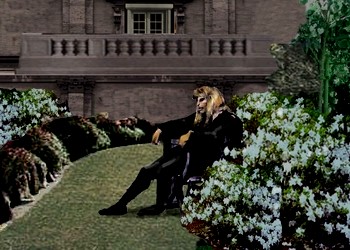
Later, after she had retired for the night and he knew she was asleep, he put a chair under her balcony, among the rose bushes, and spent the night there, keeping guard. The thought made him smile; there were no dangers near. Still, it was something he could do for her, and to be there brought him happiness.
It was peaceful sitting there with his hands clasped around one knee. The night was cool and the spicy scents of roses drifted to him. Enclosed in the walled garden, he seemed to be in the same room with her, though she slept quietly behind glass-paned doors and he sat below, awake. There was a new contentment in his soul, a happiness so deep it could not be put into words. Her change of heart had transformed everything for him. No longer did he need to torture himself with anxieties. Catherine was here to stay.
He stared out at the mounds of roses without seeing them. Another thing, far more beautiful than the flower-scented night, filled his mind. He didn’t even realize he spoke it aloud.
"Nothing whatsoever."