On the occasion of the re-opening of the
Crystal Rose Lending Library and the linkage of the Library with the Qfer,
here is some background about the Qfer and how it came to be.
For many fans, it’s hard to believe (and for
others, it’s hard to remember!) that when Beauty and the Beast
first aired on CBS in the 1980s, the vast majority of fans did not have
computers or access to them, and the Internet, for all intents and
purposes, did not exist for the general public. So when most fans wanted
to talk about the show, they had to telephone or write to each other, or
physically get together. Fandom burgeoned as fan communities sprang up all
over the world, generally based along city or regional lines, although an
international fan club was established early on. Almost immediately, fans
began to write about the show – publishing club newsletters, letterzines
in which fans could submit comments about the show to be shared with other
subscribers, and episode analyses and synopses. Fans also were writing fan
fiction and creating art – lots and lots of fanfic, and lots and lots of
art! But how were they going to get these creations out to a wide audience
in those pre-Internet days?
Following the example of other pre-Internet
fandoms such as that for Star Trek, fan magazines, known as "fanzines"
(usually shortened just to "zines") soon began to be published. The
earliest Beauty and the Beast fanzines appeared while the show was
still in its initial run. Zines such as Above and Below and
Tunnels started selling via snail mail and at professionally run
conventions such as Creation Cons. Within several years of the first
airing of Beauty and the Beast, the number of zines had blossomed
from a dozen or so published in 1988 to hundreds of zines by 1991; in all,
approximately 800 Beauty and the Beast zines are known to have been
published, many running into the hundreds of pages.
Most of these early zines sold in the hundreds
of copies each – a few close to a thousand. Fandom was hungry for good
fanfic and artwork, and as fan-run conventions began to be held, the
audience eager for zines met the publishers of those zines, who now had an
outlet to easily sell to the hundreds of fans who attended those early
conventions, and to the many hundreds more who were in organized fandom
communities all around the world. Flyers advertising zines were sent out
in letterzines and newsletters, and passed out at conventions. But there
was no organized way to distribute information about all of the zines
available.
Most zines were published in the U.S., but many
zines came from Canada, England and Australia. Shipping costs could be
high. It was an embarrassment of riches. There were so many zines
available, no one fan could afford to buy every one. Fans who wanted to
know how to order them or who wanted to know what they contained relied on
word of mouth, trial and error, borrowing, and on a small number of very
basic compendia that tried to compile ordering information to assist fans
in their search for fanfic.
What is the Qfer?
Mark and Kimberley Hartman were
fans who started the Helper’s Network in the U.S. to disseminate
information about the show, and they decided to create a compendium of
fanzines along the lines of those already being sold. However, for
whatever reasons, they left fandom after a few years, turning over the
Helper’s Network and the idea of producing the fanzine compendium to
another fan.
One of the most active fans in the early days of
fandom was Nan Dibble. She wrote fanfic, published fanzines, and was also
a professional writer in the non-fandom community under pseudonyms. Nan
took on the reins of the Helper’s Network, and from Fall of 1991
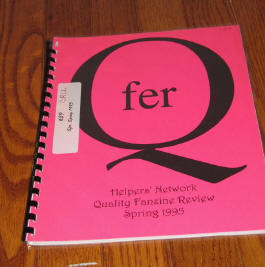
until 1997, Nan published periodic issues of the Helpers’ Network
Quality Fan Review, commonly referred to as the Qfer or the Q-fer.
Here is what Nan stated as her goal in the first
Qfer: "We want the Q-fer to be both an overview and an ordering guide to
every zine currently in print." In another issue, she described the
contents of each Qfer: "The Q-fer [gives] information on all Beauty and
the Beast creative fanzines (fiction, poetry, art, and miscellaneous – for
instance, puzzle books, coloring books, calendars, cookbooks) known to be
in print." Nan also advised in the first Qfer that neither out-of-print
nor upcoming zines would be included, although ads would be accepted for
zines to be published soon.
For several years the Qfer was published
quarterly; issues were designated Winter, Spring, Summer and Fall and came
out at the end of January, April, July and October. Beginning with the
Summer 1992 issue, fans had a choice of ordering the full quarterly Qfer
or a smaller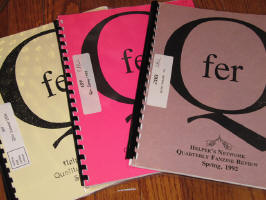 Update containing only information that was new or had changed since the
previous issue.
Update containing only information that was new or had changed since the
previous issue.
The first issue (Fall 1991) was $5; after that, full Qfers were priced at
$6 apiece, and updates were $3. For a very short time, Nan offered
subscriptions for the full quarterly Qfers at $22 per year; however, this
offer ended by early1992. By at least Spring 1994, the prices had gone up
to $8 for a full Qfer and $5 for an update. Notice was given in the Summer
1994 issue that following the Fall 1994 Qfer, publication would be
switched to twice a year, with Winter and Summer publications, issued in
February and August respectively.
In the 1997 issue of the Qfer, Nan advised that
she was departing from her previous practice of listing only in-print
zines, as she had learned that fans used the Qfer when purchasing used
zines. In fact, for many years now, the Qfer has been used exclusively for
this purpose, as the publication of hardcopy zines has all but ceased, a
victim of rising printing costs, a smaller fandom, and the increasing
relevance of the Internet.
Shortly after publication of the last hardcopy
Qfer in 1997, Nan allowed an online version to be posted. It can be found
in archive form on the Songs of the Blue Bird website. As it says on that
site, the Qfer is "one of the most important and most informative
references in the entire fandom."
While it’s not known how extensively the Qfer
was read, in the Fall 1993 Qfer, Nan mentions that "[e]ach issue of the
Q-fer reaches more than 200 B&B fans…." When one considers that the fans
in the numerous fan clubs which existed at the time shared zines,
newsletters and publications such as the Qfer, it’s probable that the
influence of the Qfer extended much farther than the number of fans who
purchased it.
How was the Qfer developed?
In the first issue, Nan advised that Mark and Kimberley
Hartman, former proprietors of Helper’s Network, were the original
planners of the Qfer. She reported that she got nothing from them "except
their goodwill and blessings in carrying on." Nan mentioned that the
Hartmans had collected subscriptions (names and funds) for their proposed
Qfer which were not turned over to Nan. The exact nature of the Hartman’s
financial or publication problems are not known to this writer, nor the
status of refunds, other than what Nan reported in the first of her Qfers.
The Hartmans had enlisted Margaret Basta to
write zine reviews for their version of the Qfer which never came to
fruition; Margaret had done a substantial amount of work for them, which
was then updated and expanded when Nan took over the project.
The Qfer was no small undertaking. In the fall
of 1991, Nan began the Qfer with four other reviewers: the above-mentioned
Margaret Basta, along with Beth Druhan, Betty Mills and Lucy Green – all
with extensive familiarity with Beauty and the Beast fan fiction, most
being fanfic writers with zine publishing experience as well. By Nan’s
count, for the first Qfer they had nearly 400 zines to mention, if not
write full reviews on; Nan advised that "[o]ver 96% of the entries have at
least a brief review" in the first Qfer. She also mentioned in the Spring
1992 edition that she had "read about 90% of the zine titles listed in
this issue…even when someone else wrote the review, by way of oversight
and checking consistency." Nan further reported in various issues that
"some zines have been evaluated by as many as seven reviewers" (this
writer assumes this was to establish the star ratings described below).
Nan mentioned in the Fall 1991 Qfer that the ordering information in the
Qfer was initially based on Beth Druhan’s Fictionzine Database, which had
been sold at the time. The information from that publication was "added to
as new zines or fresher information came to the editor’s attention."
In the Spring 1992 issue, Nan notified readers
that "[n]ow that most reviews of existing zines are complete, current
zines are primarily reviewed by Nan Dibble, with occasional help from
volunteer reviewers – not confined to the four others named above." Nan,
however, did not accept reviews submitted by any fan who wanted to write
one. If the Qfer staff had not reviewed a zine that a fan owned, Nan asked,
instead, that the fan lend her personal copy to the Qfer staff. She
preferred, however, that zine publishers send her review copies of zines,
in part so that she could ascertain the best ordering information for
specific zines. In these ways, the Qfer could expand without costing Nan
or her reviewers the price of individual zines.
What was in a hardcopy Qfer?
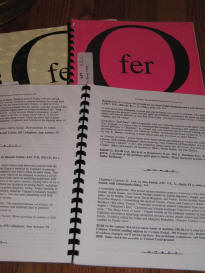 Each
Qfer contained, as has been mentioned, as much information on each zine in
print as could be compiled by the editor. This included title, writer or
editor, date of publication, which coupling the zine focuses on, rating (G-X,
often assigned by the reviewer), size, description of the zine’s contents
(including artists, writers and specifics on stories), price and ordering
information, and a star rating assigned by the reviewer - from one to five
stars, to denote the reviewer’s assessment of the overall quality of the
zine. The Qfers also included information on the status and dependability
of zine publishers (since the focus was on zines that were in print at the
time of publication). Occasionally the Qfers included information on fans
wishing to sell or swap zines, as well as flyers for upcoming publications.
Each
Qfer contained, as has been mentioned, as much information on each zine in
print as could be compiled by the editor. This included title, writer or
editor, date of publication, which coupling the zine focuses on, rating (G-X,
often assigned by the reviewer), size, description of the zine’s contents
(including artists, writers and specifics on stories), price and ordering
information, and a star rating assigned by the reviewer - from one to five
stars, to denote the reviewer’s assessment of the overall quality of the
zine. The Qfers also included information on the status and dependability
of zine publishers (since the focus was on zines that were in print at the
time of publication). Occasionally the Qfers included information on fans
wishing to sell or swap zines, as well as flyers for upcoming publications.
It appears (reading between the lines) that some
controversy existed regarding the star rating system. In the Winter 1992
issue, Nan advised that several zine publishers "have been very vocal in
wishing the star ratings to be done away with; however, a highly informal
poll…conducted when the Qfer first came out, indicates that the
overwhelming majority of those asked prefer the star ratings to be
retained…." In the Fall 1993 issue, Nan wrote: "The Q-fer is an evaluative
publication. Judgments are made. If you’d prefer a bare-bones listing,
including only facts, not opinions, we recommend you order any of the
other guides to zines we’re happy to find now available." She goes on to
say: "No one ever agrees with all reviews – even professional reviewers
differ."
Why was it necessary to create the consolidated
online Qfer?
As Nan herself noted often, the primary utility of the Qfer
was for fans to have access to information on in-print zines. As zines
went out of print, reference to them was removed from future Qfers. By the
time the 1997 Qfer was issued – the one in which Nan changed this practice
- many zines had already been dropped from the Qfer.
Jackie N. and JoAnn B. approached Nan with the
idea of going through all the Qfers in order to create a comprehensive
list of all Beauty and the Beast fanzines that had been published
throughout the years and posting it online, as well as adding zines which
had been issued since the Qfer ceased publication. Nan was enthusiastic
about the project, and lent them a number of Qfers for research purposes,
although even Nan no longer had a full set of them. Still, between what
Nan sent and what they had collected, Jackie and JoAnn had a large number
of issues from which to draw.
It was noted above that apparently there were
some fans who felt the ratings system was not as objective as it could be.
Of course, fans will always disagree on which zines are great and which
are merely good (and which are not good at all!). Although Nan had
intended the Qfer to be "evaluative" at a time when other "just the facts"
zine listings were available, those other listings had all long since
ceased publication after the Qfer became the "gold standard" for reviews.
Thus, when Jackie and JoAnn began to prepare the consolidated Qfer, there
were no other comprehensive zine listings online, and in order to create
as objective a list as possible for the one such list that would be kept
updated online, Jackie and JoAnn received permission from Nan to remove
the ratings, and to shorten the reviews in order to remove some subjective
comments.
Jackie and JoAnn worked on the project, on and
off, for about two years, debuting the
consolidated
online Qfer in mid-2001, on the Monday prior to the start of the New
York convention. Nan herself announced its appearance in her online
Helper’s Network Hotline on July 16, 2001.
What’s the future of the consolidated online Qfer?
Nan passed away in March 2006, but her legacy lives on in
the consolidated online Qfer. As the years go by, more zines are added –
both those published after the Qfer ceased publication and older zines
that became available for review.
Is the Qfer still relevant now that so much
fanfic is posted online? Absolutely! Because the truth is that, no matter
how much fanfic is posted online, it’s a mere drop in the bucket compared
to the amount of fanfic that’s locked in hardcopy format in hundreds of
zines. This is one reason the Crystal Rose Lending Library is so important
to fandom – the only way to read much of our wonderful fan fiction and see
most of the gorgeous artwork created by fans is to find them in hardcopy
zines.
Work progresses on finding fans who no longer
are active in fandom to get permission to post their work online. But this
is a very slow process, and in fact, some writers and artists prefer that
their work not ever be posted online. So borrowing or buying hardcopy
zines still is the only way – now and in the foreseeable future – to read
and see much of this fiction and art.
However, the consolidated online Qfer is still not a complete overview of
every Beauty and the Beast zine ever published. Jackie and JoAnn,
with Aliset now assisting in a major way, are still hampered by the lack
of availability of some zines, mostly those published outside of the U.S.
If a zine isn’t in the Qfer, or if information
is missing regarding a listed zine, it’s because they haven’t been able to
get the information needed to post it. Fans with zines missing from, or
with incomplete information in, the consolidated online Qfer are urged to
contact the Qfer’s caretakers so that additional information can be posted.
In 2011, the caretakers of the Qfer and Carole
W., the Librarian, and her staff for the Crystal Rose Lending Library
joined forces. With the permission of the Qfer caretakers, the Library
developed an incredible searchable database using data from the Qfer.
Major updates to the Qfer will be made in the coming months in
coordination with the Library staff. You can anticipate a lot of new
information being added by the end of 2011. Using both the Library and the
Qfer will now be easier than ever!
JoAnn Baca
September 25, 2011
back to index
back to BatBland